
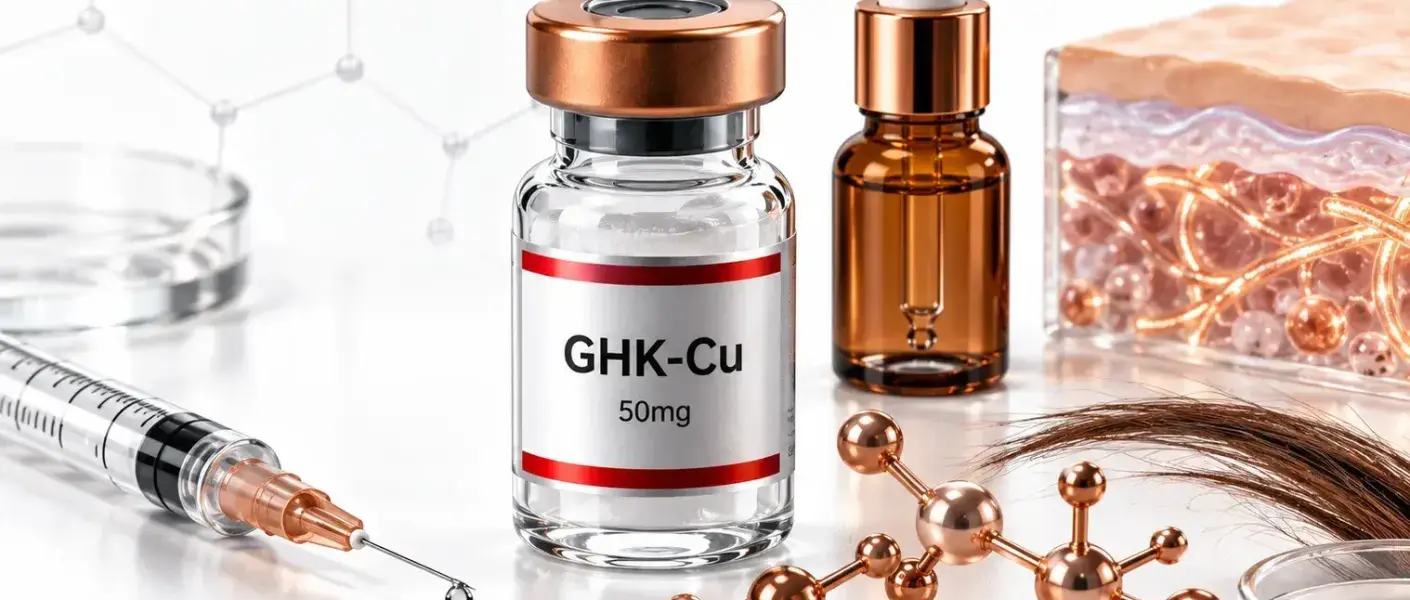
GHK-Cu Copper Peptide: Skin, Hair and Injectable vs Topical
GHK-Cu is a naturally occurring copper peptide that has become one of the most searched research peptides for skin, hair and connective tissue. This guide covers what GHK-Cu is, what the research actually shows, typical research dosing, how to do the 50 mg vial math, and the honest difference between topical and injectable use. GHK-Cu is a research chemical: there is no approved drug product, and nothing here is medical advice.
What Is GHK-Cu and How It Works
GHK-Cu is the copper complex of the tripeptide glycyl-L-histidyl-L-lysine (GHK). The peptide occurs naturally in human plasma, saliva and urine, and its concentration falls with age, which is the main reason it is studied for skin repair, wound healing and tissue remodelling. The copper ion is not a decoration: the peptide works largely as a carrier that delivers copper into cells and into copper-dependent enzymes.
Two mechanisms matter for anyone buying GHK-Cu. First, it upregulates collagen synthesis and the metalloproteinases that break down and remodel old, damaged collagen, so the effect appears as gradual changes in skin firmness and texture rather than as an overnight result. Second, it has an anti-inflammatory and antioxidant action in the tissue around an injury, which is why wound care and topical skincare are the areas with the most human data.
What the Research Shows
Most of the human evidence is topical, not injectable. A controlled study of GHK-Cu cream applied twice daily for 12 weeks reported improved collagen production in 70 percent of the women treated, along with increased skin density and fewer fine lines. Wound healing and post-procedure skin repair have been studied with topical formulations, while the injectable route rests mainly on animal work and mechanism.
| What is studied | What the research shows | Strength of evidence |
|---|---|---|
| Skin firmness and collagen (topical) | 12-week cream study: collagen improvement in about 70 percent of participants, better skin density, fewer fine lines | Human study |
| Wound healing and skin repair (topical) | Faster closure and better quality of repaired tissue in clinical and animal models | Human and animal |
| Hair and scalp (topical) | Small studies report thicker hair and reduced shedding; sample sizes are small | Limited human data |
| Systemic anti-aging (injectable) | Proposed collagen and gene-expression effects; no human trials of injectable GHK-Cu exist | Mechanism and animal data |
| Half-life in blood | Sources disagree and the main review of GHK-Cu gives no single figure: about 30 minutes in plasma in one source, 2 to 4 hours in another, which is why frequent dosing is used in practice | Contradictory sources |
The short plasma half-life explains the practical side of GHK-Cu: topical products rely on local penetration, and injectable protocols use regular, often daily, administration rather than a single weekly shot.
Typical Dosage and Cycle Length
Standard research protocols run GHK-Cu in a cycle rather than continuously, and the range is narrow compared with most peptides.
| Weeks | Daily amount | What happens | Drawing it at 5 ml water |
|---|---|---|---|
| 1-2 | 1 mg per day | Adjustment phase, temporary dryness is possible | 0.1 ml (10 units) |
| 3-6 | 1 to 2 mg per day | First visible changes in skin texture and elasticity | 10 to 20 units |
| 7-12 | 1 to 2 mg per day | Collagen remodelling, density and scalp coverage | 10 to 20 units |
| After 8-12 weeks | 4 to 6 weeks off | Cycle break before the next round | - |
The vial math decides how long a cycle runs in practice: a 50 mg vial lasts about seven weeks at 1 mg per day and about three and a half weeks at 2 mg per day, so an 8 to 12 week cycle takes two vials at the lower dose and up to four at the higher one. Vendor protocols published online differ in shape - some run a shorter 30-day ramp and finish the vial faster - but the weekly math above is what you are actually drawing after reconstitution.
| Route | Typical research range | Frequency | Notes |
|---|---|---|---|
| Topical | 1 to 2 percent cream or serum | Once or twice daily | Start 2 to 3 times a week for the first two weeks to limit irritation |
| Subcutaneous | 1 to 2 mg per day (online protocol guides, not trial data) | Daily, abdomen or thigh | Above 3 to 4 mg per day protocol guides report headaches; human trials used topical creams, not injections |
| Cycle | 8 to 12 weeks on | Then 4 to 6 weeks off | Benefits accumulate over weeks and across cycles |
Reconstitution: GHK-Cu 50 mg Vial Math
GHK-Cu arrives as a lyophilized powder and has to be reconstituted with bacteriostatic water. The arithmetic is simple, but it decides how many units you draw. On a U-100 insulin syringe 0.1 ml equals 10 units.
| Bacteriostatic water added | Concentration | What 0.1 ml (10 units) contains | Volume for a 1 mg dose |
|---|---|---|---|
| 2.5 ml | 20 mg/ml | 2 mg | 0.05 ml (5 units) |
| 5 ml | 10 mg/ml | 1 mg | 0.1 ml (10 units) |
| 10 ml | 5 mg/ml | 0.5 mg | 0.2 ml (20 units) |
For any vial the formula is the same: milligrams divided by millilitres gives the concentration, and the dose you want divided by that concentration gives the volume to draw. Adding more water makes the injection more accurate at small doses; adding less water keeps the injection volume smaller. Use the same water volume every time so your numbers stay reproducible.
Topical vs Injectable: Which One Fits the Goal
| Aspect | Topical GHK-Cu | Injectable GHK-Cu |
|---|---|---|
| Best for | Face, scalp, localized skin and scar areas | Whole-body collagen, tissue repair and longevity research protocols |
| Evidence | Human 12-week cream study, wound care data | Mechanism and animal data only |
| Onset | 4 to 6 weeks for visible texture changes | Proposed systemic buildup over the cycle |
| Main downside | Temporary dryness and irritation in the first weeks | Injection site reactions, no human safety data for this route |
If the goal is skin and hair, topical is the route with actual human data, and the injectable version is a research tool rather than a proven upgrade. If the goal is a systematic repair protocol, GHK-Cu is normally stacked rather than used alone, which is where the next section comes in.
Side Effects and Precautions
- Temporary skin dryness in the first one to two weeks of topical use, sometimes called the copper reaction; it usually settles as collagen remodelling begins.
- Irritation and redness at the application site, more likely with higher concentrations and with daily use from day one.
- Headaches reported at doses above 3 to 4 mg per day in injectable protocols, well above standard research dosing.
- Injection site reactions with subcutaneous use, plus the general risks of injecting a non-sterile or poorly handled product.
- No approved drug status. There is no FDA-approved GHK-Cu drug product, so what is sold online is an unapproved research chemical rather than a medicine. US compounding rules for peptides were updated in 2026 - see the FDA 503A bulk drug substances page for the current position.
Storage and Handling
Keep the lyophilized powder refrigerated at 2 to 8 C, protected from light, until it is reconstituted. Once in solution, store it refrigerated and use it within a few weeks; avoid repeated temperature changes and never freeze a reconstituted peptide. Topical products stay stable at room temperature but should be kept out of direct sun. As with any peptide, record the reconstitution date on the vial so you know exactly how old it is.
How to Stack GHK-Cu
GHK-Cu carries the collagen and anti-inflammatory layer, so it is usually combined with peptides that cover other parts of repair. The common combination is the so-called GLOW stack, also available as a ready-made blend (Glow Blend by Dragon Pharma, or the four-peptide version Klow Blend): GHK-Cu 50 mg by British Dragon together with BPC-157 5 mg for tendon, gut and soft tissue support, and TB-500 5 mg for cell migration and flexibility. Each of the three works through a different pathway, which is why the stack is popular rather than any single peptide.
For the growth hormone side of recovery, GHK-Cu protocols are sometimes paired with Ipamorelin 5 mg or Sermorelin 5 mg, both of which raise endogenous GH and are easier on appetite and cortisol than older secretagogues - or combine them as a ready 50/50 vial (CJC-1295 no DAC with Ipamorelin). When running more than one peptide, keep the same reconstitution volume per vial and log injections so the numbers stay clear.
All of these are available in the British Dragon brand range at XSteroids, and each product page carries its own dosage and reconstitution data.
Related Products
The product in this guide: copper peptide for skin, hair and connective tissue research.
Tendon, gut and soft tissue support; the base of the GLOW stack.
Cell migration and flexibility; the second half of the Wolverine and GLOW stacks.
Selective GH secretagogue, often paired with CJC-1295.
Frequently Asked Questions
What is GHK-Cu used for?
GHK-Cu is a copper peptide studied for skin repair, collagen production, wound healing and hair support. Most human evidence comes from topical creams used for 8 to 12 weeks, where studies report better skin density, improved collagen production and fewer fine lines. Injectable use is a research practice without human trial data.
What is the typical GHK-Cu dosage?
Topical products are usually used at 1 to 2 percent once or twice daily, starting two to three times a week to limit irritation. Research protocols for subcutaneous use run about 1 to 2 mg per day, with 8 to 12 weeks on and 4 to 6 weeks off. Doses above 3 to 4 mg per day are associated with headaches.
How do I reconstitute a 50 mg GHK-Cu vial?
Add bacteriostatic water and divide to get the concentration: 5 ml gives 10 mg per ml, so 0.1 ml on a U-100 insulin syringe (10 units) equals 1 mg, and 10 ml gives 5 mg per ml, so 10 units equals 0.5 mg. Keep the same water volume for every vial.
Topical or injectable GHK-Cu - which is better?
For skin and hair, topical is the better-supported route because the human studies used creams. Injectable GHK-Cu is used in research settings for systemic collagen and repair goals, but there are no human trials of that route, and it carries injection-related risks.
How long does GHK-Cu take to work?
Expect the adjustment phase to last about two weeks, with temporary dryness possible. Noticeable changes in skin texture and elasticity are usually reported between weeks 4 and 6, and the full effect is judged at the end of an 8 to 12 week cycle rather than in the first month.
Is GHK-Cu legal and FDA approved?
There is no FDA-approved GHK-Cu drug product, so GHK-Cu sold online is an unapproved research chemical rather than a medicine. US compounding rules for peptides were updated in 2026, which changed how some peptides are handled but did not approve them (see the FDA 503A list). Products sold online are not quality-controlled as medicines are.
Where to buy GHK-Cu online?
You can buy GHK-Cu 50 mg from the British Dragon range at XSteroids, supplied as a lyophilized 50 mg vial with tracked shipping: 3 to 6 days for US domestic delivery and 12 to 26 days international. Check the product page for current availability and reconstitution details.