Quick View
Loading...

British Dragon
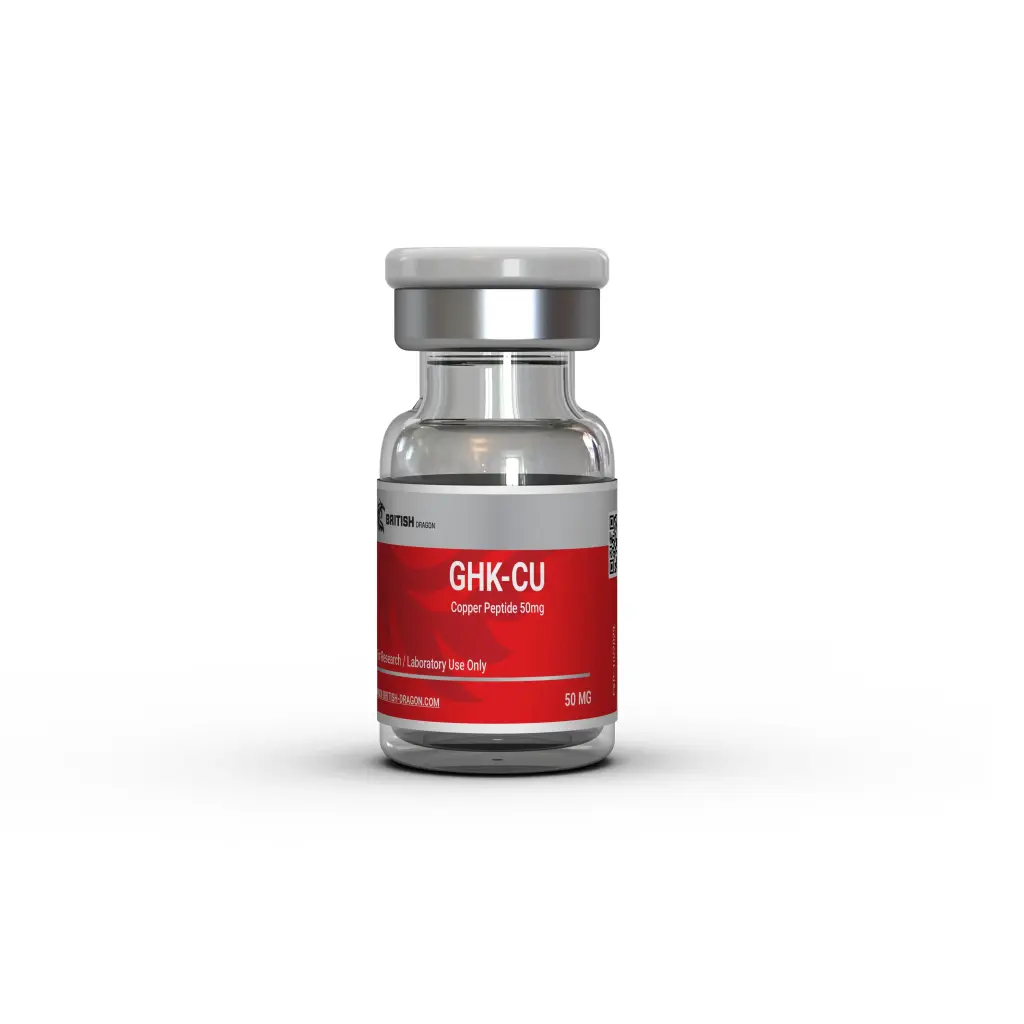
Buy GHK-Cu 50 mg vials by British Dragon at XSteroids. GHK-Cu is the copper peptide research uses for collagen, skin and connective tissue work, supplied by British Dragon as a lyophilized 50 mg vial that is dissolved before use. This page covers what it is, how one 50 mg vial calculates at three dilutions, why the solution turns blue and how to store it.
GHK-Cu is not an approved medicine anywhere; sold here it is a research product and the notes below are educational.
GHK-Cu is a copper complex of the tripeptide glycyl-L-histidyl-L-lysine, bound one to one with copper(II). The tripeptide has a high affinity for copper and that binding is what makes it active, so the complex is what research works with rather than the bare peptide. At 400.90 g/mol it is one of the smallest peptide products in this catalogue, and in the body it circulates at roughly 200 ng/ml at age 20, dropping to about 80 ng/ml by 60.
Research describes it as a matrikine: a fragment released when tissue is damaged that signals repair. The reported effects are collagen and glycosaminoglycan synthesis in skin fibroblasts, antioxidant and anti-inflammatory activity, and support for new blood vessel growth. That is also why it appears in cosmetics as a restorative ingredient.
The brand instruction for a 50 mg vial is 2 to 5 ml of bacteriostatic water, which gives roughly 10 to 25 mg per ml. That one range covers three practical set-ups.
At the research reference of 1 to 2 mg a day, one 50 mg vial covers 25 to 50 days. Topical work is different: it uses a 0.5 to 2 percent solution, and then the vial lasts however long the carrier lasts, so there is no clean conversion from milligrams to percent without knowing the carrier volume.
This is where honesty is needed. The human data on GHK-Cu comes from skin application, not from injections. A 2018 review describes 12 weeks of topical GHK-Cu on thigh skin improving collagen production in 70 percent of the women studied, and a 2015 review reports faster wound healing and better skin graft take. No human study compares the injected and topical routes, and injecting copper peptides is ahead of the evidence - that is the fair reading, not a reason to claim the opposite.
Once reconstituted, GHK-Cu has a clear blue tint. The colour is the copper in the complex and it is normal. A solution that is cloudy, or that has visible particles, is a different matter and should be discarded.
Before mixing, keep the lyophilized powder dry and cool, away from light and moisture, at 15 to 25 C or in the fridge at 2 to 8 C. Do not freeze the powder. After reconstitution, store at 2 to 8 C and use within 30 days, avoid repeated freeze-thaw cycles, and do not use a cloudy solution. These are the brand's own storage rules for this vial.
There is no separate human side effect profile for injectable GHK-Cu, and long-term safety data for that route does not exist. The documented caution is a balance problem: the peptide stimulates both metalloproteinases, which break down dermal proteins, and their inhibitors, which is why the reference source says to use it with care. In sport there is no data on an official ban - GHK-Cu simply does not appear in the 2026 WADA list, which is not the same as a clearance.
GHK-Cu is usually discussed alongside the other repair peptides. BPC 157 and TB 500 cover tendon, gut and systemic soft tissue work, while GHK-Cu is the skin and connective tissue option. Where growth hormone release is the subject instead, the line has Ipamorelin and Sermorelin.
British Dragon GHK-Cu 50 mg comes straight from the brand catalogue with secure checkout, US domestic delivery in 3 to 6 days and international delivery in 12 to 26 days. The rest of the range sits on the British Dragon page.
Yes. Both names describe the same complex: the tripeptide Gly-His-Lys bound to copper in a one to one ratio. Cosmetic labels usually call it copper tripeptide-1, laboratory listings call it GHK-Cu, and the molecular mass is about 400.90 g/mol in both cases.
There is no human study comparing the two. The human evidence is topical: 12 weeks of application improved collagen production in 70 percent of the women studied. Injection is used in research settings with animal data behind it, so those topical results cannot simply be transferred to a subcutaneous injection.
No. GHK-Cu is not an approved drug anywhere. It is used as a cosmetic ingredient, where collagen support is the claim, and it is sold for research use as a lyophilized vial. Injectable copper peptides sit ahead of the published evidence rather than behind it.
No official ban could be found. GHK-Cu does not appear in the 2026 prohibited list and no regulator document names it. That is an absence of data rather than a clearance, so treat the position as unconfirmed rather than permitted and check the current list before competing.
All 50 mg, and the arithmetic after reconstitution depends on the water. With 2 ml the vial is 25 mg per ml, with 3 ml about 16.7 mg per ml, and with 5 ml 10 mg per ml. At 1 to 2 mg a day the vial lasts 25 to 50 days.
Because of the copper. The complex is one tripeptide bound to one copper ion, and that metal centre absorbs light in a way that gives a blue colour. It is a normal property of the reconstituted solution, not a sign of degradation, but a solution that is cloudy should be thrown away.
You can buy GHK-Cu 50 mg vials by British Dragon online at XSteroids. The store offers secure checkout, US domestic shipping in 3 to 6 days and international delivery in 12 to 26 days. Add the vial to your cart on this page to order.
Loading...
Your cart is currently empty. Let us assist you in finding the right product