
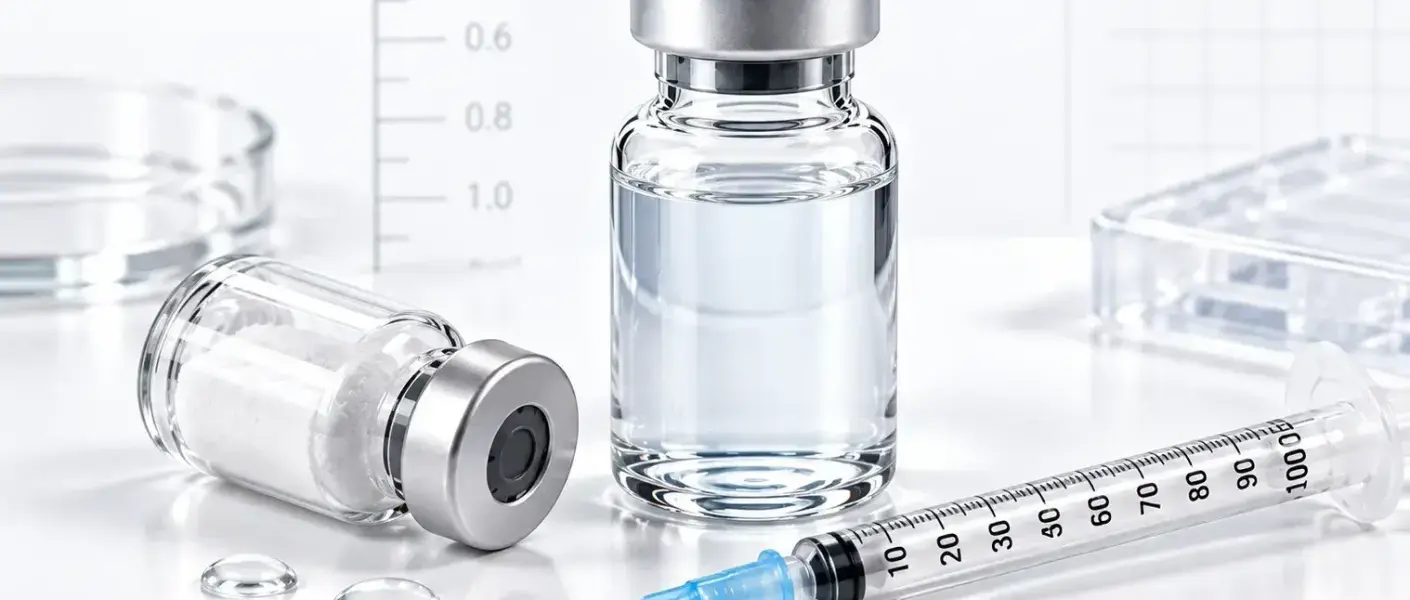
Bacteriostatic Water: How Much to Use per Vial
Bacteriostatic water is the diluent almost every peptide vial needs, and the question that decides everything is how much of it to add. This guide gives the math, ready-made tables for 2, 5, 10 and 50 mg vials, how many units that means on a U-100 insulin syringe, and the storage and safety rules straight from the official label.
What Bacteriostatic Water Actually Is
Bacteriostatic Water for Injection USP is sterile water for injection with a preservative: 0.9 percent benzyl alcohol (9 mg per ml) or 1.1 percent (11 mg per ml), supplied in a multiple-dose vial so you can withdraw from it more than once. The label puts the pH at 5.7, in a range of 4.5 to 7.0. That preservative is the whole point - it is what allows repeated withdrawals without the water going bad after the first entry.
Two label lines are worth knowing before you buy anything. First: not for use in neonates - benzyl alcohol is associated with toxicity in newborns, and where water is needed for a neonate only preservative-free sterile water should be used. Second: the label states the product must be made approximately isotonic before direct use, which is why it is a diluent for a powder rather than something you inject on its own.
Bacteriostatic Water vs Sterile Water
| Aspect | Bacteriostatic water | Sterile water for injection |
|---|---|---|
| Preservative | 0.9 to 1.1 percent benzyl alcohol | None |
| Repeated withdrawals | Yes, multiple-dose vial | Not intended for repeated use |
| Use case | Reconstituting lyophilized peptides for a multi-dose schedule | Infusion, or where preservative-free water is required |
| Neonates | Not for use (label warning) | The preservative-free option for that age group |
| Sting at injection | Reported more often because of the alcohol | Less likely, but single-use |
The Only Three Numbers You Need
Peptide reconstitution is arithmetic, not chemistry. Three lines get you any dose:
- Concentration = milligrams of peptide divided by millilitres of water added.
- Volume to draw = dose you want divided by that concentration.
- Units = on a U-100 insulin syringe, 1 ml is 100 units, so 0.1 ml is 10 units and 0.25 ml is 25 units.
Example: a 5 mg vial with 5 ml of bacteriostatic water is 1 mg per ml, so a 250 mcg dose is 0.25 ml, which is 25 units. The same vial with 2 ml of water is 2.5 mg per ml, so 250 mcg becomes 0.1 ml, or 10 units. You are trading injection volume against precision: more water means a larger, more accurate draw; less water keeps the draw small.
How Much Water per Vial: Ready-Made Tables
5 mg vial
| Water added | Concentration | 100 mcg | 250 mcg | 1 mg |
|---|---|---|---|---|
| 1 ml | 5 mg/ml | 2 units | 5 units | 20 units |
| 2 ml | 2.5 mg/ml | 4 units | 10 units | 40 units |
| 3 ml | 1.67 mg/ml | 6 units | 15 units | 60 units |
| 5 ml | 1 mg/ml | 10 units | 25 units | 100 units |
2 mg, 10 mg and 50 mg vials
| Vial | Water | Concentration | Common dose | Units |
|---|---|---|---|---|
| 2 mg | 2 ml | 1 mg/ml | 100 mcg | 10 units |
| 10 mg | 2 ml | 5 mg/ml | 250 mcg | 5 units |
| 10 mg | 5 ml | 2 mg/ml | 250 mcg | 12.5 units |
| 50 mg | 5 ml | 10 mg/ml | 1 mg | 10 units |
How Many Doses One Vial Gives
| Vial | Daily dose | Days per vial | Vials for an 8-week cycle |
|---|---|---|---|
| 5 mg | 250 mcg | 20 days | 3 |
| 10 mg | 250 mcg | 40 days | 2 |
| 10 mg | 500 mcg | 20 days | 3 |
| 50 mg | 1 mg | 50 days | 2 |
Storage: What the Label Says and What People Do
Unopened bacteriostatic water is stored at 20 to 25 C (68 to 77 F), which is ordinary controlled room temperature - no refrigerator needed. The label is stricter about what comes after reconstitution: mix thoroughly, use promptly, and do not store reconstituted solutions of drugs for injection unless the manufacturer of the solute directs it. It also tells you to use aseptic technique for every entry, and never to use the water if the solution is not clear or the seal is broken.
Practice in the peptide community is looser: vials are kept in the refrigerator at 2 to 8 C after reconstitution and used over several weeks. Both statements are worth knowing - the label is the safety position, and the practice is what most people actually do. If you follow the practice, keep the vial cold, never reuse a needle to draw, and note the reconstitution date on the label.
Safety and Handling
- Never use it for neonates. The label carries a direct warning because of benzyl alcohol toxicity in newborns.
- Not for standalone injection. The label describes it as a diluent and notes it must be made approximately isotonic before use.
- Clear solution only. Do not use if the liquid is cloudy, has particles, or the seal is damaged.
- Alcohol sting. Benzyl alcohol can make injections more noticeable; this is commonly reported, not a medical finding.
- No stability data for peptides. There is no comparative study of peptides reconstituted with bacteriostatic water versus preservative-free water, so any claim about which keeps a peptide stable longer is an assumption rather than a result.
Related Products
The diluent this guide is about, ready to pair with any lyophilized peptide.
The same product from the Kalpa line.
A typical 5 mg vial - the tables above fit it directly.
The 50 mg example used in the tables.
Frequently Asked Questions
How much bacteriostatic water do I add to a 5 mg vial?
Most protocols use 2 ml to 5 ml. With 2 ml the concentration is 2.5 mg per ml, so 250 mcg equals 10 units on a U-100 syringe; with 5 ml it is 1 mg per ml, so the same dose equals 25 units. More water gives a more accurate draw, less water keeps the injection volume small.
How many units is 250 mcg?
It depends on the concentration, not on the dose alone. A 5 mg vial with 2 ml gives 250 mcg in 10 units; the same vial with 5 ml gives it in 25 units; a 10 mg vial with 2 ml gives it in 5 units. Divide the dose by the concentration, then multiply by 100 for a U-100 syringe.
Is bacteriostatic water the same as sterile water?
No. Bacteriostatic water contains 0.9 to 1.1 percent benzyl alcohol as a preservative, which allows repeated withdrawals from one vial. Sterile water for injection has no preservative, so it is single-use, and it is the option the label names when water is needed for a neonate.
Can I use saline or tap water instead?
Do not. Tap water is not sterile, and saline adds sodium chloride, which changes the solution you are drawing. The label's own position is that this product is a diluent for drugs that need dissolving in an aqueous vehicle, and the same standard applies to any substitute.
How long does a reconstituted peptide last in the fridge?
The manufacturer label says to use reconstituted solutions promptly and not to store them unless the solute's manufacturer directs otherwise. Peptide practice is to refrigerate at 2 to 8 C and use the vial over a few weeks. If you do that, keep it cold, use aseptic technique, and mark the date of reconstitution.
Why does bacteriostatic water sting more?
Because of the benzyl alcohol preservative. This is one of the most common complaints in vendor and community descriptions rather than a documented clinical finding. If the sting is a problem, preservative-free sterile water is the alternative, with the tradeoff of single-use handling.
Where to buy bacteriostatic water online?
You can buy bacteriostatic water from the Dragon Pharma and Kalpa lines at XSteroids, supplied as multiple-dose vials that pair with any lyophilized peptide in the store. Orders ship in 3 to 6 days for US domestic delivery and 12 to 26 days international.