Quick View
Loading...

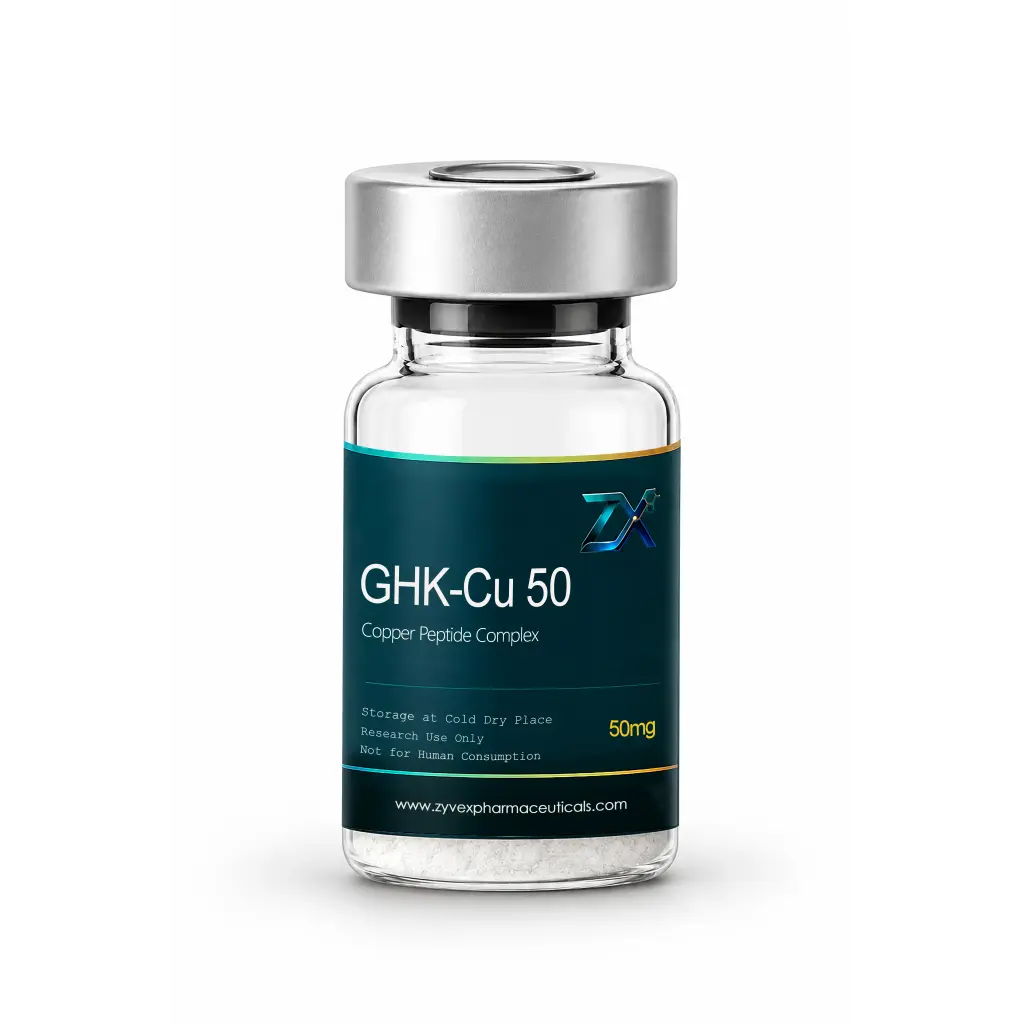
Zyvex Pharmaceuticals
Buy GHK-CU 50 mg by Zyvex at XSteroids. This is a single 50 mg vial of lyophilised GHK-CU, the copper complex of the tripeptide glycyl-L-histidyl-L-lysine. The page explains what the molecule is, how the copper changes it, which effects the published work supports and which claims run ahead of it, how a researcher mixes a 50 mg vial and reads it on a U-100 barrel, and the storage rule that applies to a blue solution.
The status statement matters here. GHK-CU has no licensed medicine form; it is used as a cosmetic ingredient, and nearly all human data come from applying it to skin rather than injecting it. The vial sold here is a research product, and nothing below is a treatment recommendation.
GHK-CU is the naturally occurring copper complex of the tripeptide Gly-His-Lys, with a 1:1 stoichiometry between the peptide and copper II. The formula is C14H21CuN6O4 with a mass of about 400.90 g/mol, PubChem CID 139035031. In cosmetics the same molecule appears under the name copper tripeptide-1. Human plasma carries roughly 200 ng per ml at age twenty, falling to about 80 ng per ml by sixty.
One glass vial per pack contains 50 mg of white to blue powder, and bacteriostatic water is sold separately. After mixing, the solution takes on a distinct blue colour because of the copper in the complex; that is expected rather than a defect. There is no published filler list and no independent potency test for this batch.
The peptide is a matrikine: a fragment released when tissue is damaged, which signals repair. Copper binding is not decoration, it is required for biological activity. In cell and animal work GHK-CU stimulates collagen and glycosaminoglycan synthesis in skin fibroblasts, increases protein and DNA accumulation in dermal wounds, supports blood vessel growth, and raises release of BDNF, VEGF and BMP-2. It also attracts immune cells and shows antioxidant and anti-inflammatory effects.
There is a caution printed in the source material that belongs on the page. GHK-CU stimulates the matrix metalloproteinases that break down dermal proteins as well as their inhibitors, so it regulates both assembly and breakdown of the matrix, and the source advises using it with care. No human half-life is established for the peptide, which means any published schedule is practice rather than pharmacokinetics.
The human evidence is narrow in route. In a 2018 review, GHK-CU applied to the skin of the thigh for twelve weeks improved collagen production in seventy percent of the women studied, and a 2015 review records faster wound healing and contraction plus better graft take. Those are topical results. There is no comparable body of human work for subcutaneous injection, so topical findings cannot simply be moved to a syringe.
Regulatory status is equally clear: GHK-CU has no licensed medicine form and is regulated as a cosmetic ingredient. In anti-doping, the substance does not appear on the WADA Prohibited List, and this page treats that as "no official prohibition found" rather than as permission, because absence from a list is not a statement of safety.
The mass of the complex is spread through whatever volume of water is used. Dilute the 50 mg with two millilitres and every millilitre then carries 25 mg, which places 2.5 mg in a 0.1 ml draw. Raise the volume to 5 ml and the same vial delivers 10 mg per ml, putting 1 mg into the draw. At 10 ml each millilitre carries 5 mg and the 0.1 ml draw holds 0.5 mg. Adding more water weakens the mixture and forces a bigger draw for the same mass.
A U-100 barrel is ruled into 100 units to the millilitre, which makes each unit 0.01 ml, so a 0.1 ml draw always falls on the ten unit mark. Supplier literature describes research amounts in the region of 1 to 2 mg per day in animal and in vitro work; at 1 mg per day a 50 mg vial would stretch to about fifty days. That is a laboratory landmark, not a label dose.
GHK-CU is the skin and connective tissue member of the repair group, so it is often discussed alongside the peptides that work on other tissue. BPC 157 covers gut and local tissue angles and TB-500 is treated as a systemic actin-binding agent, which makes the three a natural trio in a bench write-up rather than a choice between them.
Outside the repair shelf, the metabolic peptides Semaglutide 10 and Retatrutide 20 answer different questions and are not part of a collagen line. All of these vials need the same diluent, and it is sold separately.
GHK-CU leaves the testosterone axis untouched, so no suppression occurs and no restart protocol applies. Nothing in endocrine terms needs to be recovered. The relevant oversight is local: skin or injection site condition, and whether a wound or lesion is being managed by a clinician rather than by a cosmetic peptide.
Where it is used beside an anabolic cycle, post-cycle planning belongs to that cycle. Because the peptide has no licence or label in any country, there is no manufacturer instruction on duration, ceiling or monitoring, and any study block is defined by the researcher.
No injection safety database exists for GHK-CU, and the human studies used topical application. The source material warns that the peptide drives both matrix breakdown and matrix repair, which is the reason for its cautious wording. Copper itself is not inert, so a compound that delivers copper into tissue deserves more caution than its cosmetic reputation suggests. A research vial is also outside pharmaceutical quality control.
Legally, GHK-CU is handled as a cosmetic ingredient and a research chemical, so the rules differ by country and none of them treat this vial as a medicine. With no WADA entry, athletes are not facing a listed prohibition, but the absence of a listing should not be read as a clearance.
Before mixing, hold the powder between 15 and 25 C or in a cold store at 2 to 8 C, away from light and moisture. Do not freeze the lyophilised powder, because ice crystals damage the peptide. Sealed vials remain stable for a long time under those conditions.
Once mixed, the blue liquid is kept cold at 2 to 8 C and used up within a month. Freezing it again is out of the question, since each thaw costs stability, and a vial whose contents go cloudy or show specks should be thrown away. The colour may deepen or shift slightly and that is expected, whereas cloudiness is not. Keep it away from light and out of reach of children.
The 50 mg vial is listed in the Zyvex brand catalog at XSteroids, on the same shelf as the other repair peptides and the diluent, so the whole bench can be equipped from one order. Payment is processed over an encrypted connection. A parcel inside the US normally takes three to six days, while international delivery needs twelve to twenty-six days. The vials normally bought with this one are named in the cards underneath.
Yes. Copper tripeptide-1 is the cosmetics trade name for the same molecule: the tripeptide Gly-His-Lys complexed with copper II in a 1:1 ratio, formula C14H21CuN6O4, mass about 400.90 g/mol. Literature also refers to the peptide alone as GHK.
Because of the copper in the complex. The blue colour appears once the powder dissolves and is a normal property of the copper-peptide complex rather than a sign of contamination. Cloudiness or visible particles are different and mean the vial should be discarded.
No. There is no licensed medicine form of it in any country, and it is regulated as a cosmetic ingredient. Nearly all human data come from topical use, so there is no human evidence base for injection. This vial is sold as a research product rather than a medicine.
Divide the mass by the water added. With 2 ml the solution is 25 mg per ml, so 0.1 ml holds 2.5 mg. With 5 ml it is 10 mg per ml and 0.1 ml holds 1 mg. On a U-100 barrel every 0.1 ml reads as 10 units.
Vendor literature describes 1 to 2 mg per day in animal and in vitro research, and topical studies use solutions of about 0.5 to 2 percent. At 1 mg per day a 50 mg vial covers roughly fifty days, but these are research landmarks and not a label dose for people.
No entry for GHK-CU was found on the 2026 WADA Prohibited List. That is reported here as no official prohibition found, not as a clean bill of health, because absence from a list says nothing about safety or about local rules on research chemicals.
You can buy GHK-CU 50 mg by Zyvex online at XSteroids, direct from the brand catalog. Add the vial on this page to the cart and check out securely. US domestic shipping takes 3 to 6 days and international delivery usually takes 12 to 26 days.
Loading...
Your cart is currently empty. Let us assist you in finding the right product