Quick View
Loading...

Zyvex Pharmaceuticals
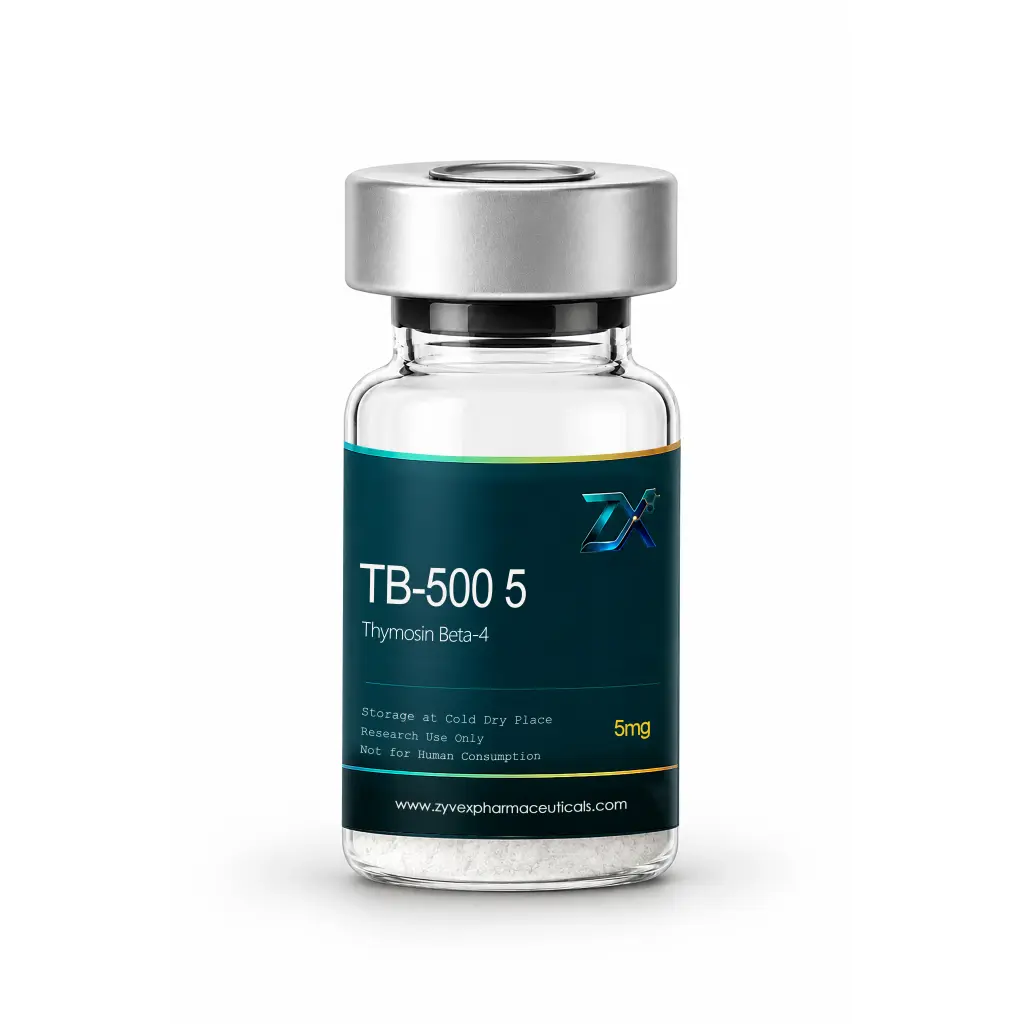
Buy TB-500 by Zyvex at XSteroids. Zyvex ships this thymosin beta-4 fragment as a single lyophilised vial for bench research. The page explains what the heptapeptide actually is, why vendors and science disagree about its size, how it travels in the body, what is honestly known about the human data, how the vial is mixed and read on a U-100 barrel, and where it stands in anti-doping rules.
The status is simple and worth stating first: TB-500 has never been tested in humans, it has no licensed medicine form, and it is sold here as a research product. The clinical data that do exist belong to the parent protein, not to this fragment. Nothing below is a human protocol or medical advice.
The science is clear about the molecule: TB-500 is Ac-LKKTETQ, an N-acetylated heptapeptide of seven amino acids, matching residues 17 to 23 of the protein thymosin beta-4. Its identifiers are CAS 885340-08-9, PubChem 62707662 and the formula C38H68N10O14. The parent protein is a 43 amino acid chain of about 4921 g/mol coded by the gene TMSB4X.
One glass vial per pack holds lyophilised powder, and bacteriostatic water is needed before measurement and is sold separately. The catalog record for this offer does not print a fill strength, so this page does not invent one. Vendors often describe TB-500 as a seventeen amino acid fragment, which the primary literature does not support; the seven residue acetylated peptide is what the name refers to.
The active motif LKKTET binds G-actin, the monomeric form of the protein that makes up the cell skeleton. By binding there the peptide influences actin polymerisation and, through that, cell motility and migration. The parent protein also has extracellular roles that run outside the actin pathway, and those are credited with part of the regenerative activity described in the literature. These are mechanisms observed in cells and animals.
What is missing is human kinetics. No half-life has been established for the fragment in humans, and vendor pages repeat the same absence of a figure rather than filling the gap. That matters for anyone comparing schedules, because without a human half-life there is no pharmacological basis for choosing injection frequency from data.
The fragment has no clinical record. The clinical work that exists was done with the whole thymosin beta-4 protein, largely as an eye drop formulation, and it cannot be transferred to a subcutaneous peptide by assumption. Vendor literature lists angiogenesis, lower pro-inflammatory cytokines, increased collagen synthesis and keratinocyte migration; those are supplier claims, not trial results.
Regulatory status follows the same gap: TB-500 has no licensed medicine form. In sport the picture is explicit rather than grey: WADA names thymosin beta-4 and its derivatives in class S2 of the Prohibited List with the wording "Thymosin-b4 and its derivatives e.g. TB-500", and the prohibition applies at all times, in and out of competition.
Every figure comes from dividing the mass by the volume of water used. Two millilitres added to a 5 mg vial leaves 2.5 mg in each millilitre, which puts 250 mcg into a 0.1 ml draw. Drop to 1 ml with the same vial and each millilitre now holds 5 mg, so the 0.1 ml draw carries 500 mcg. A 10 mg vial behaves the same way: 2 ml yields 5 mg per ml, and 5 ml yields 2 mg per ml, so the 0.1 ml draw holds 200 mcg.
A U-100 barrel divides one millilitre into 100 equal marks, so a single mark is 0.01 ml and ten of them are 0.1 ml no matter what has been dissolved. Note the strength and the date of mixing on the vial before it goes into storage. Wipe the stopper before each draw, let the water run down the inside wall instead of onto the cake, and rotate the vial gently rather than shaking it, since foam and shear break a peptide apart.
The standard pairing in research literature is the gut and local tissue peptide. BPC 157 is studied for local effects while TB-500 is treated as systemic, since the actin motif travels through circulation and does not require the needle to reach an injury site. Nothing about the combination has a licensed medicine form.
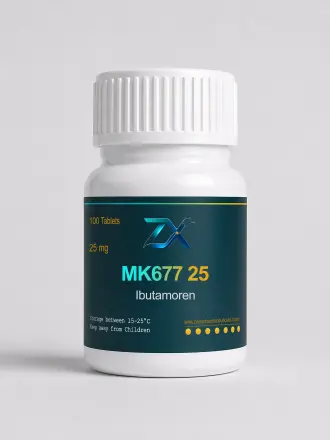
The copper tripeptide GHK-CU 50 is the third element of the repair group on this shelf, aimed mainly at skin and connective tissue in the published work. Growth hormone secretagogues such as Ibutamoren MK 677 sit in a different part of the catalog and answer a different research question.
TB-500 does not touch the testosterone axis, so it causes no suppression and requires no restart protocol. There is nothing to recover pharmacologically. The practical controls are local: keep the injection site clean, watch for swelling, and rest the tissue being studied.
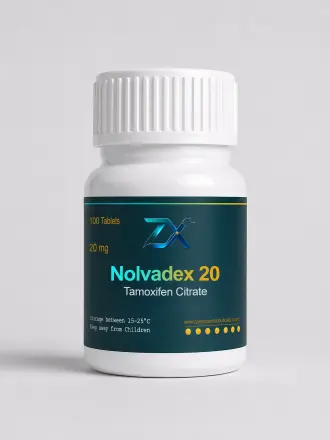
If the peptide is used alongside an anabolic compound, post-cycle planning belongs to that compound. Zyvex keeps the two shelves apart: the recovery items, from Nolvadex to Clomid, sit in their own section of the catalog. Because the fragment has no licence and no label, there is no manufacturer instruction on cycle length, dose ceiling or blood work, and a study block is defined by the researcher.
There is no human safety database for the fragment, so no side effect profile can be quoted honestly. The parent protein has a clinical history as an eye preparation, but that route and formulation are not comparable to a subcutaneous injection of a fragment. A research vial also sits outside pharmaceutical quality control, so purity and mass depend on the supplier.
Legally the peptide is not a medicine in any jurisdiction and is handled as a research chemical, so its status follows local rules. In anti-doping it is unambiguous: class S2 of the WADA list, named explicitly through the thymosin beta-4 entry, and it applies in and out of competition without any window.
An unopened vial is best kept refrigerated between 2 and 8 C and shielded from light. The powder itself must not be frozen, because ice crystals wreck peptide structure, though a short spell at a controlled 15 to 25 C is fine while a parcel is in transit. Kept that way, a sealed vial holds its quality for a long period.
After mixing, the liquid goes into the refrigerator at 2 to 8 C and should be finished inside four weeks, which is the window normally applied to a peptide in solution. It must not be frozen again, and repeated thawing shortens its life. If the liquid turns cloudy or specks appear in it, the vial is spent. Keep it where children cannot reach it.
The vial appears in the Zyvex brand catalog at XSteroids next to the other repair peptides and the diluent they all require, so a single order stocks the whole bench. Payment is taken through an encrypted connection. Domestic US parcels normally arrive in three to six days, and international shipments take twelve to twenty-six days. The cards below list the vials this one usually shares a session with.
No. Thymosin beta-4 is a 43 amino acid protein of about 4921 g/mol coded by the TMSB4X gene. TB-500 is Ac-LKKTETQ, an acetylated seven amino acid fragment matching residues 17 to 23 of that protein, so it is a fragment rather than the whole molecule.
That description circulates on supplier pages but is not supported by the primary literature, which identifies TB-500 as an acetylated heptapeptide of seven residues. The page presents both positions rather than hiding the conflict, and the scientific identification is the one to work from.
No. No half-life has been established for the fragment in humans, and supplier pages repeat the same absence rather than supplying a figure. Without human kinetics there is no data-based reason for a particular injection frequency, so any published schedule is practice, not pharmacology.
Divide the mass by the water volume. A 5 mg vial with 2 ml is 2.5 mg per ml, so 0.1 ml holds 250 mcg. A 10 mg vial with 5 ml is 2 mg per ml and 200 mcg per 0.1 ml. On a U-100 barrel each 0.1 ml reads as 10 units.
No. The peptide is described as acting systemically: its actin-binding motif travels through circulation, so research write-ups do not depend on the needle reaching a specific tissue. That is the opposite of the local-tissue framing used for BPC 157, which is why the two are discussed as a pair.
Yes, at all times. WADA names thymosin beta-4 and its derivatives in class S2 of the Prohibited List, with TB-500 given as the example. The prohibition applies in and out of competition, and there is no licensed medical use that would support a therapeutic exemption.
You can buy TB-500 by Zyvex online at XSteroids, direct from the brand catalog. Add the vial on this page to the cart and check out securely. US domestic shipping takes 3 to 6 days and international delivery usually takes 12 to 26 days.
Loading...
Your cart is currently empty. Let us assist you in finding the right product