Quick View
Loading...

Kalpa Pharmaceuticals
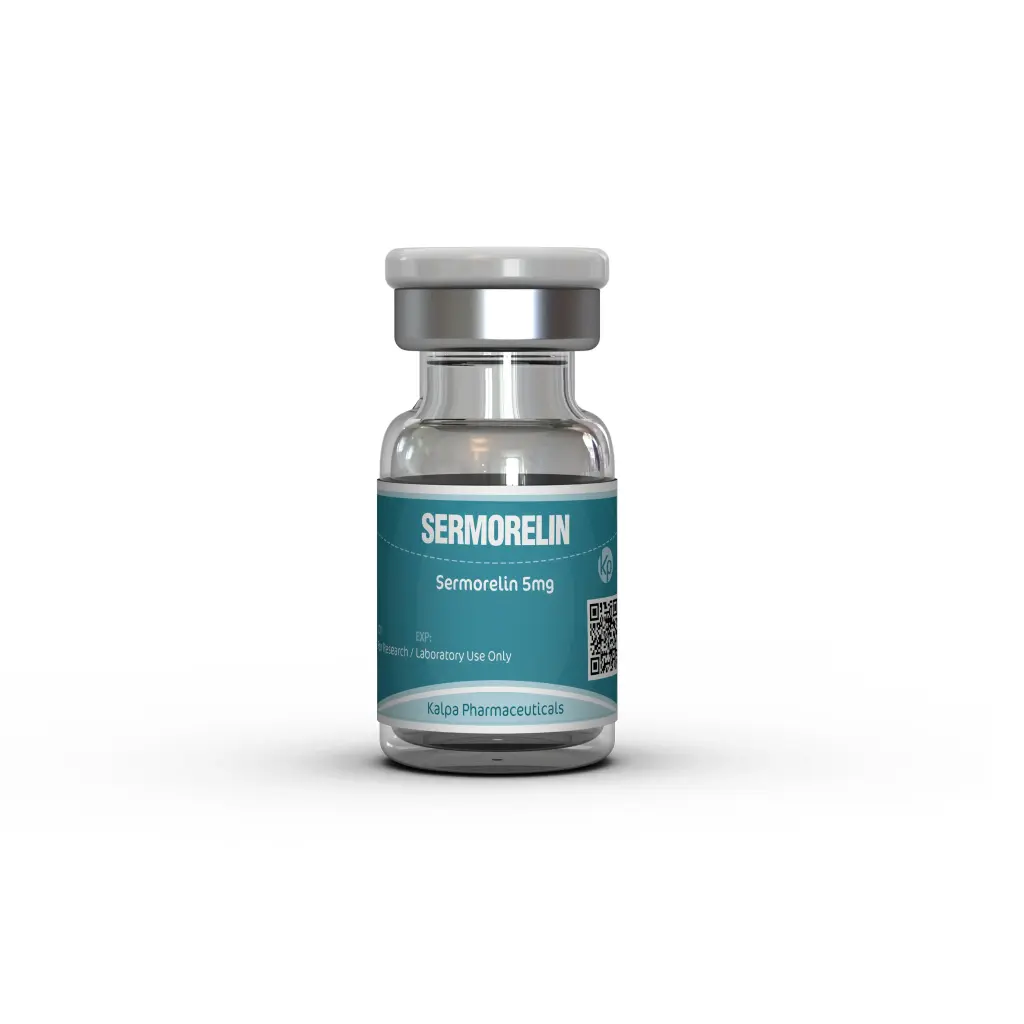
Buy Sermorelin 5 mg by Kalpa Pharmaceuticals at XSteroids. This GHRH peptide arrives from Kalpa as one vial of lyophilised powder meant for laboratory work. Here you get the chemistry, the pituitary mechanism, the old clinical record, the mixing arithmetic and the current regulatory and anti-doping picture, and the page describes what you are buying at each step.
Its status comes before the detail: sermorelin once held a prescription, that product is gone, and what ships today is a research material for laboratory work with no licensed medicine form. Treat the content as background, not as a dosing plan or medical guidance.
Sermorelin is the acetate salt of GHRH(1-29), also written GRF 1-29. That makes it a 29-amino-acid fragment of growth hormone releasing hormone, the natural hypothalamic signal to the pituitary, acting as an agonist at the GHRH receptor. It was once a prescription medicine under the names Geref and Gerel.
One sealed glass vial holding white powder at 5 mg ships here, with bacteriostatic water a separate item. Kalpa prints the mass on the label; the page carries no filler list and no independent potency report for the batch, so the contents rest on the manufacturer as with any research vial.
The peptide binds the GHRH receptor on the pituitary and prompts the gland to release its own growth hormone. It does not add hormone from outside; it raises the body's own output, which means the axis keeps its feedback control and the release follows the body's own rhythm rather than a fixed infusion.
The half-life surrounding this molecule is very short. In rats, GHRH(1-29)-amide given intravenously cleared with a half-life near 6.2 minutes, and vendor reference material quotes roughly 10 to 20 minutes. Either way the number is measured in minutes, not hours, so the effect on growth hormone is a pulse rather than a sustained plateau. That short action is normal for the GHRH family and does not by itself make the compound useless.
The clinical history is real but old. As a prescription product, sermorelin was used both as a diagnostic test at about 1 mcg per kg intravenously and as a treatment at 100 to 500 mcg per day subcutaneously, with children dosed near 30 mcg per kg. A 1997 study of the analogue [Nle27]GHRH(1-29)-NH2 at 10 mcg per kg subcutaneously for sixteen weeks recorded a rise in growth velocity, but that work was on an analogue, not on sermorelin itself.
Geref was withdrawn from the US market in July 2008, and the withdrawal was not for safety reasons. Sermorelin ships today as a research material with no licensed medicine form, so the vial carries no label dose. Vendor claims about anti-ageing or body composition come from the compound's history rather than from a product that exists now.
What the record leaves open matters as much as what it settles. There is no agreed human half-life, the figures behind the old clinical work belong to a different era, and this fill carries no published concentration data, no filler list and no separate potency report. The peptide itself is the acetate of residues 1 to 29 of growth hormone releasing hormone, the shortened piece that still activates the pituitary GHRH receptor, while the longer native hormone is not what the vial holds. A reader should therefore keep three things apart: what the fragment does at the receptor, what the prescription product did years ago, and what the vial sold today can be shown to do, for which no study exists.
Begin with the ratio, because the syringe only shows liquid. One milligram of peptide per millilitre is what five millilitres of water give this fill; two millilitres push it to 2.5 mg per ml; a single millilitre gives 5 mg per ml. In micrograms that reads 1000, 2500 and 5000 per millilitre. Each 0.1 ml on a U-100 scale is ten units, so a ten-unit draw delivers 100, 250 or 500 mcg according to the volume chosen, and a 5 mg vial covers about sixteen draws at 300 mcg or roughly five at 1000 mcg. Because the fill is small against those volumes, a small error in the water added shifts the concentration noticeably, so a syringe is worth using for the dilution step itself.
Introduce the water along the vial wall, swirl gently, never shake, and put the ratio and the mixing day on the label before refrigeration.
Sermorelin binds the GHRH receptor while its classic partner binds the ghrelin receptor, a separate pituitary input. That partner here is Ipamorelin 5 mg, and the two are usually studied as a pair because they prompt one output through two doors rather than doubling a single signal.
Elsewhere on the shelf the vial keeps company with the repair compounds BPC 157 2 mg and GHK-CU 50 mg, which act elsewhere entirely, and with the prescription Kalpatropin product. Each arrives dry and relies on the same bacteriostatic water.
A third GHRH entry on the same shelf is Tesamorelin 5 mg, a stabilised synthetic analogue of the hormone. It is studied on its own evidence base, and nothing measured for it transfers to sermorelin, so the two are neighbours at the receptor rather than substitutes for one another.
A GHRH analogue leaves the androgen axis untouched, so it produces no shutdown and needs no post-cycle protocol of its own. The only recovery question is whether pituitary output returns to baseline once a block stops, and the historical evidence does not describe lasting suppression.
When the vial is studied alongside an anabolic cycle, the recovery plan stays exactly where it was and belongs to that cycle. Since there is no licensed medicine form today, there is no label guidance on duration, and the honest position is that a study block is set by the researcher. Anyone comparing this vial to a current prescription should treat the old clinical figures as background rather than as a present template.
The historical clinical profile included injection-site reactions, flushing, headache and dizziness, and long use could raise cortisol through the axis. The data are limited and old. As a research material it stands outside pharmaceutical manufacturing controls, so purity and exact mass are down to the supplier.
Regulatorily, the picture is simple: there is no licensed medicine form today. In sport the prohibition is explicit. WADA's 2026 list covers GHRH and its analogues inside class S2 and names sermorelin directly, which means a permanent ban, with no in-competition window and no exemption to apply for.
The dry vial belongs at 2 to 8 C and away from light, although short spells at 15 to 25 C are acceptable. Never freeze the powder, since freezing injures the peptide. In cold, dark storage the lyophilisate holds for a long period.
Keep the vial inside its original carton until the day it is used, because the card is what keeps light off the powder, and let a chilled vial reach room temperature while still sealed so that condensation does not collect on the stopper. Refreezing the powder or the mixed solution is the one handling step that can spoil either of them.
Reconstituted, keep the solution at 2 to 8 C and draw on it for no more than a month, matching the 28 to 30 day expectation for peptides. Reject a vial that has been refrozen or that shows cloudiness or specks. Keep children away from it.
This 5 mg vial is listed in the Kalpa Pharmaceuticals brand catalog at XSteroids beside the ghrelin-receptor partner and the water both require, so a research setup can ship in one pass. The checkout is encrypted, US delivery generally arrives within 3 to 6 days and international shipping takes 12 to 26 days. The related cards below show what usually travels with it.
Sermorelin was sold as a prescription medicine under the names Geref and Gerel and was withdrawn from the US market in July 2008, and not for safety reasons. No licensed medicine form exists today, so the vial sold here carries no label dose and is a research material.
It depends on the water added. With 2 ml the concentration is 2.5 mg per ml, so 0.1 ml holds 250 mcg. With 1 ml it is 5 mg per ml and 500 mcg per 0.1 ml, and with 5 ml it is 1 mg per ml and 100 mcg per 0.1 ml. On a U-100 barrel each 0.1 ml is 10 units.
Because the GHRH family is cleared very quickly. In rats, GHRH(1-29)-amide given intravenously had a half-life near 6.2 minutes, and vendor references quote about 10 to 20 minutes. The growth hormone response is therefore a pulse, not a sustained level.
They hit different receptors. Sermorelin is a GHRH receptor agonist and a fragment of the natural hypothalamic signal, while ipamorelin acts at the ghrelin receptor. Because the two pathways are separate, they are often studied together rather than as substitutes for one another.
Class S2. The 2026 Prohibited List covers growth hormone releasing hormone and its analogues and names sermorelin explicitly. The ban applies at all times, in and out of competition, with no therapeutic-use exemption available, so an athlete using it is always in violation.
Injected growth hormone adds the hormone itself from outside, while a GHRH peptide prompts the pituitary to release its own. That keeps the body's feedback loop in control, which is a different pharmacology from supplying hormone directly and changes how the two are used in research.
You can buy Sermorelin 5 mg by Kalpa Pharmaceuticals online at XSteroids, straight from the brand catalog. Add the vial on this page to the cart and finish the encrypted checkout. US shipping normally takes 3 to 6 days and international delivery 12 to 26 days.
Loading...
Your cart is currently empty. Let us assist you in finding the right product