Quick View
Loading...

Kalpa Pharmaceuticals
Estimated Delivery: 12-26 Days (International), 3-6 Days (United States)
Return within 45 Days of purchase. Duties & taxes are non-refundable.
Buy Mounjarixyl by Kalpa Pharmaceuticals at XSteroids. Mounjarixyl is the trade name Kalpa Pharmaceuticals gives its tirzepatide pack, and this page deals with the single 5 mg lyophilized vial sold under that name: what the molecule does, how a dual incretin agonist is handled on a research bench, how the powder is diluted, and what the published trials actually measured. It is a research-grade item rather than a medicine, and nothing here is a protocol for a person.
Tirzepatide, the active molecule, is a linear peptide of 39 amino acids built by Eli Lilly as a GIP analogue and then modified with a fatty diacid chain that lets it ride on albumin in the bloodstream. That chain is the reason one injection lasts days rather than hours. The molecule binds the GIP receptor and the GLP-1 receptor, which is why it is described as a dual incretin agonist rather than a single GLP-1 peptide.
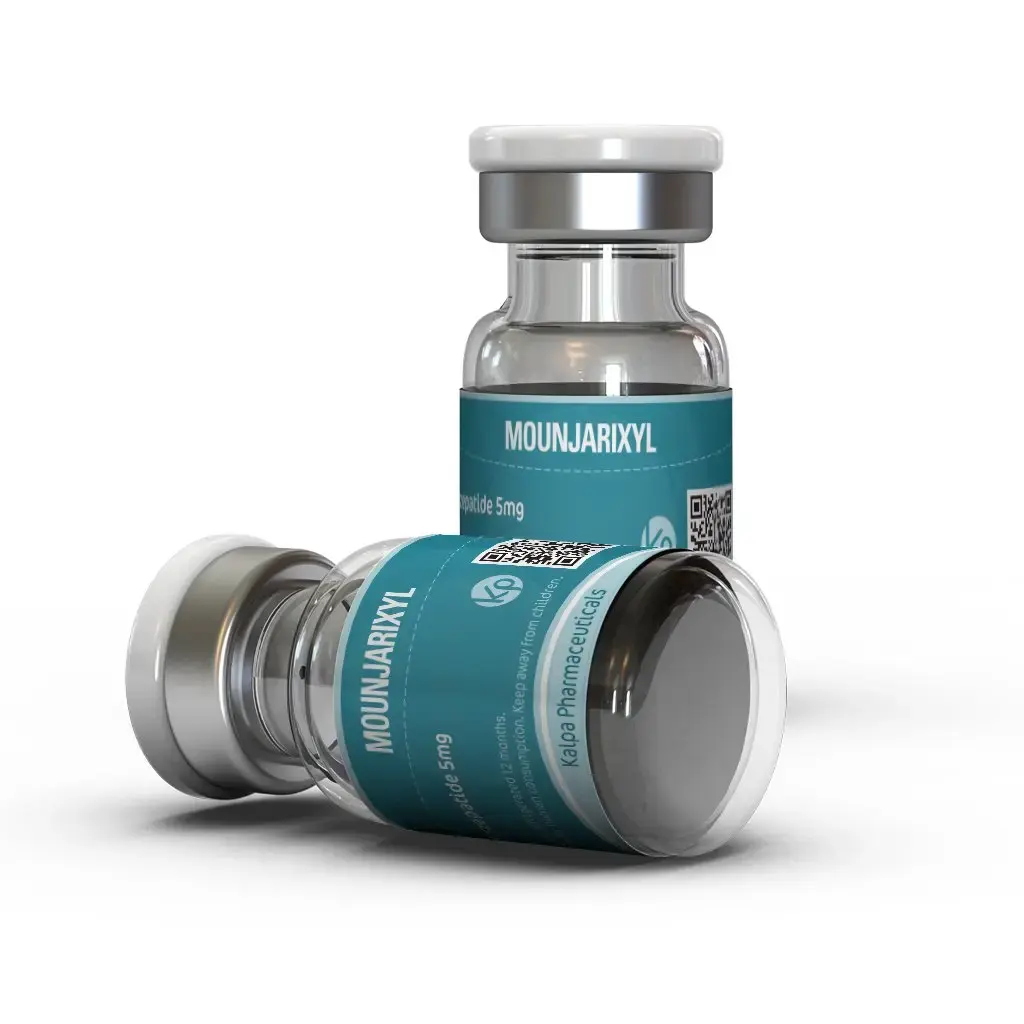
What the order contains is one glass vial of lyophilized powder holding 5 mg of the peptide, sealed with a rubber stopper and requiring water before use. It is a vial and a stopper, not a pen, not a cartridge and not a ready-to-inject device: there is no dial, no fixed dose and no needle in the box. The strength and the lot number appear on the Kalpa Pharmaceuticals box, while how the powder is dissolved is left entirely to whoever handles it. No independent assay of these particular vials has been published, so the only claim made on this page is what the label states.
The gut releases two hormones after a meal, GIP and GLP-1, and both talk to the pancreas and to the brain. Tirzepatide imitates the first and activates the receptor of the second, so a single molecule pulls two levers. In the pancreas it raises insulin release only when glucose is already high, which is why the effect is described as glucose dependent. In the stomach it slows emptying, so food sits longer and the next meal arrives later. In the brain it dampens appetite signalling, and the practical result reported in studies is a lower calorie intake without a deliberate diet.
Its affinity for the GIP receptor is higher than for GLP-1, and the two pathways are not simply additive: GIP appears to soften some of the nausea that pure GLP-1 agonism produces, while the GLP-1 arm carries the appetite effect. Albumin binding keeps the peptide in circulation for about five days in the licensed form, so once weekly dosing was enough to hold a steady level in the trials [1][2]. None of that chemistry changes because the material arrives as powder instead of liquid.
Honest answer first: the numbers below come from the licensed injectable, not from this vial. In SURMOUNT-1, 2539 adults with obesity or excess weight and no diabetes were followed for 72 weeks; the average weight change was minus 15.0 percent on 5 mg, minus 19.5 percent on 10 mg and minus 20.9 percent on 15 mg, against minus 3.1 percent on placebo, with at least 5 percent lost by 85 to 91 percent of participants depending on the arm [3]. Nothing similar has been published for a lyophilized research vial, and no assay of these vials is on record.
What appears first is appetite, not weight. Satiety shows up within the first days of a dose step, while the scale moves over months, because fat loss is gradual and the early movement is often water and gut content. Tolerance builds with the step ladder, so a dose that feels quiet in week one can feel heavy in week five. The endpoint measured in the trial was body weight and the trial needed three quarters of a year to reach it, which is a useful reminder of the timescale involved.
Everything follows one small sum: the milligrams in the vial over the millilitres of water. One millilitre into the 5 mg vial gives 5 mg per ml, so 0.1 ml carries 0.5 mg. Two millilitres give 2.5 mg per ml, so 0.1 ml carries 0.25 mg, and five millilitres give 1 mg per ml, so 0.1 ml carries 0.1 mg. On an insulin-type U-100 barrel every 0.1 ml reads as ten units, whatever volume was chosen.
Let the water run down the glass wall and swirl the powder into solution rather than shaking it, since foam can damage a peptide. Once water is in, the vial is normally finished within four weeks of refrigeration, while the untouched powder keeps far longer when it stays cool, dark and sealed. The licensed weekly ladder for the same molecule runs 2.5, 5, 10 and 15 mg, raised no faster than every four weeks, and the trial arms used 5, 10 and 15 mg [2][3]. Those are study arms, not a bench recommendation, and the water volume plus the unit markings decide what a draw actually contains.
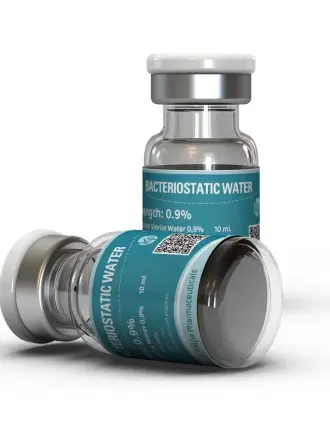
There is no established stacking protocol for this class, and anyone who claims otherwise is improvising. Appetite suppression is already strong on its own, so adding a second compound that also lowers intake mostly adds side effects rather than results. Where people do pair research items, the pairing is usually logistical rather than pharmacological: a bacteriostatic water vial for reconstitution sits beside the powder on every bench.
Thematically closer neighbours in the Kalpa range are the metabolic peptides, such as Tesamorelin 5 mg and MOTS-c 10 mg, both studied for fat and energy handling rather than for appetite. Growth-axis items like Kalpatropin, and repair peptides such as BPC 157 or Ipamorelin, belong to entirely different research questions. No human study has looked at any of these combinations together, and the honest position is that such pairings exist in forum posts rather than in data.
This is not a steroid, so nothing here shuts down testosterone and no SERM belongs in the picture. The recovery question is about appetite and weight: in SURMOUNT-4, participants who switched to placebo after an open-label run regained roughly 14 percent of body weight over 52 weeks [4]. Hunger returning quickly after a stop is the pattern this class shows, and it is why the licensed products are framed as long-term treatment rather than a course with an end date.
If a research block ends, tapering is a practical question rather than a pharmacological one, because a vial can be diluted more or drawn less. What matters is the denominator: protein intake, resistance training and sleep decide how much of the change survives. A research vial is not a plan for a body, and any decision about stopping belongs with a clinician who can see the whole picture.
The dominant complaints in the literature are gastrointestinal and dose dependent: nausea, vomiting, diarrhoea, constipation, reduced appetite that overshoots, and discomfort in the upper abdomen. Discontinuation rises with the dose, from about 5 percent on the lowest step to as much as a quarter of participants on the highest one in phase 2 work [1]. A small rise in resting heart rate, fatigue and headache are also reported, with the heart rate peak appearing around week 24 [2].
The licensed label carries two contraindications worth repeating exactly: a personal or family history of medullary thyroid cancer, and multiple endocrine neoplasia syndrome type 2 [2]. Pancreatitis is the other recurring question; a 2024 systematic review found no clear association, case reports exist, and the UK regulator updated its guidance in 2026 [1]. Anyone with a history of gallbladder disease, kidney problems or gastroparesis has a reason to be cautious. This card describes research material, and medical questions about a person belong to a clinician.
On anti-doping, the incretin class that includes this molecule is not on the prohibited list; the anti-doping agency keeps it under monitoring instead [5].
Keep the lyophilized vial cold at 2 to 8 C, upright, in its box and out of light, and never freeze it, because ice crystals damage the peptide cake. Once water has been added, the solution lives at 2 to 8 C and is normally used within 28 to 30 days; a thawed or cloudy vial should be discarded rather than used. Record the lot number and the mixing date on the label, and keep the powder away from damp air, since a lyophilized peptide takes up moisture quickly when it is warm.
Mounjarixyl sits in the Kalpa Pharmaceuticals catalog at XSteroids alongside the rest of the brand peptide shelf, so a diluent, a repair peptide and a metabolic item can travel in one parcel. The listing names the molecule and the strength instead of hiding behind a nickname. Payments run through an encrypted checkout, domestic orders normally arrive inside a week, and cross-border parcels take twelve to twenty-six days. The linked cards below list the vials most often handled next to this one.
Mounjarixyl is the Kalpa Pharmaceuticals trade name for its tirzepatide pack, supplied as one 5 mg lyophilized vial. Tirzepatide is a peptide of 39 amino acids that copies the gut hormone GIP and switches on the GLP-1 receptor at the same time, which makes it a dual incretin agonist handled in metabolic research.
It copies GIP and activates the GLP-1 receptor, so two gut hormone pathways respond at once. Insulin release rises only when glucose is already high, stomach emptying slows, and appetite signalling in the brain is dampened. The fatty acid chain on the molecule lets it bind albumin and stay active for roughly five days.
In that trial 2539 adults without diabetes were followed for 72 weeks on once weekly dosing. Average weight fell by 15.0 percent on 5 mg, 19.5 percent on 10 mg and 20.9 percent on 15 mg, against 3.1 percent on placebo. Those figures describe the licensed injectable, not a research vial.
Add water down the inside wall and swirl rather than shake. One millilitre gives 5 mg per ml, two millilitres give 2.5 mg per ml and five millilitres give 1 mg per ml. Every 0.1 ml reads as ten units on a U-100 barrel, so the volume chosen decides the strength of each draw.
No. Those are licensed injection pens made by Eli Lilly from the same molecule, supplied ready to use with a fixed dial. This pack is a 5 mg lyophilized vial sold as research-grade material, so it arrives as powder, needs diluent and carries no published assay. The label ladder does not transfer to a vial.
Mostly gastrointestinal and worse at higher doses: nausea, vomiting, diarrhoea, constipation and upper abdominal discomfort. Discontinuation climbed from around five percent on the lowest step toward a quarter of participants at the top of the phase 2 ladder. Fatigue, headache and a small rise in resting heart rate are also reported.
Kalpa Pharmaceuticals Mounjarixyl 5 mg is sold at XSteroids in the brand catalog. Add the vial on this page to the cart and complete an encrypted checkout. Delivery inside the United States usually takes 3 to 6 days, and international parcels arrive in 12 to 26 days depending on customs.
Loading...
Your cart is currently empty. Let us assist you in finding the right product