Quick View
Loading...

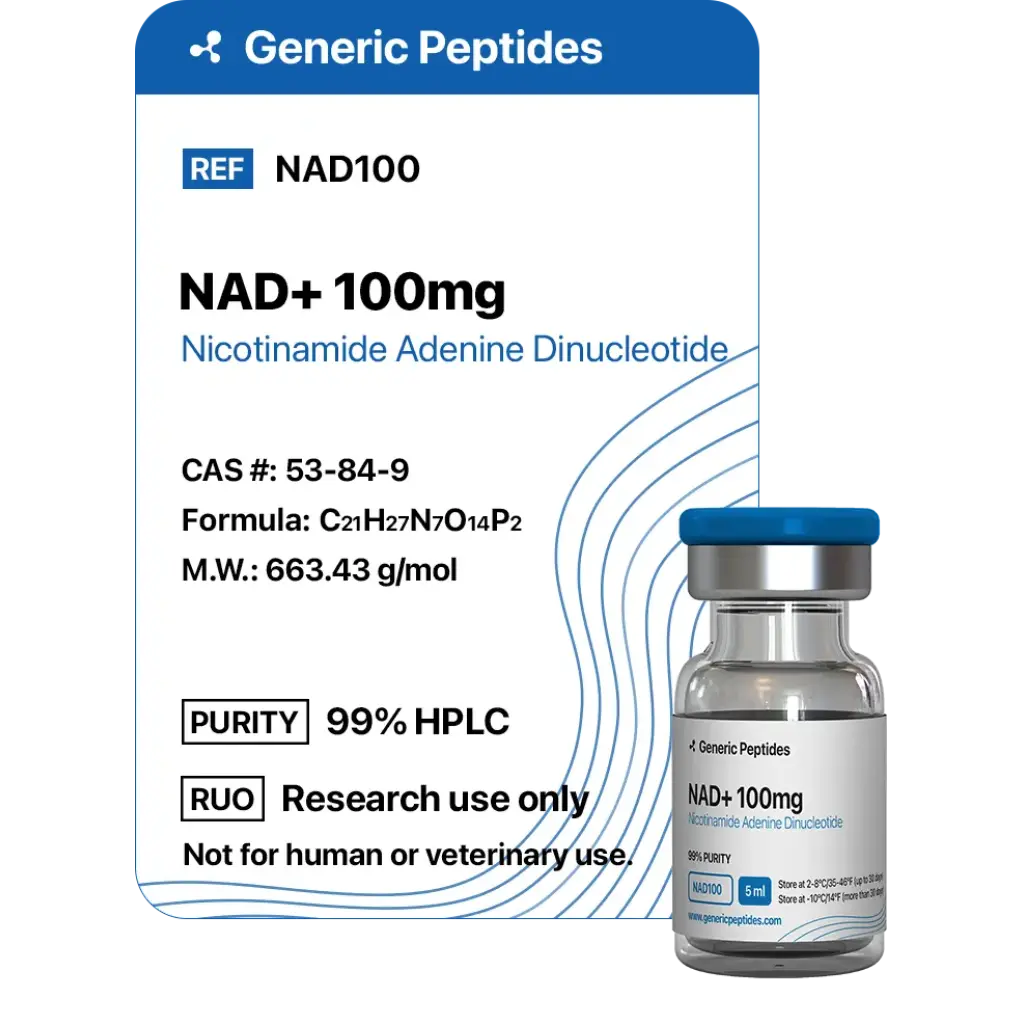
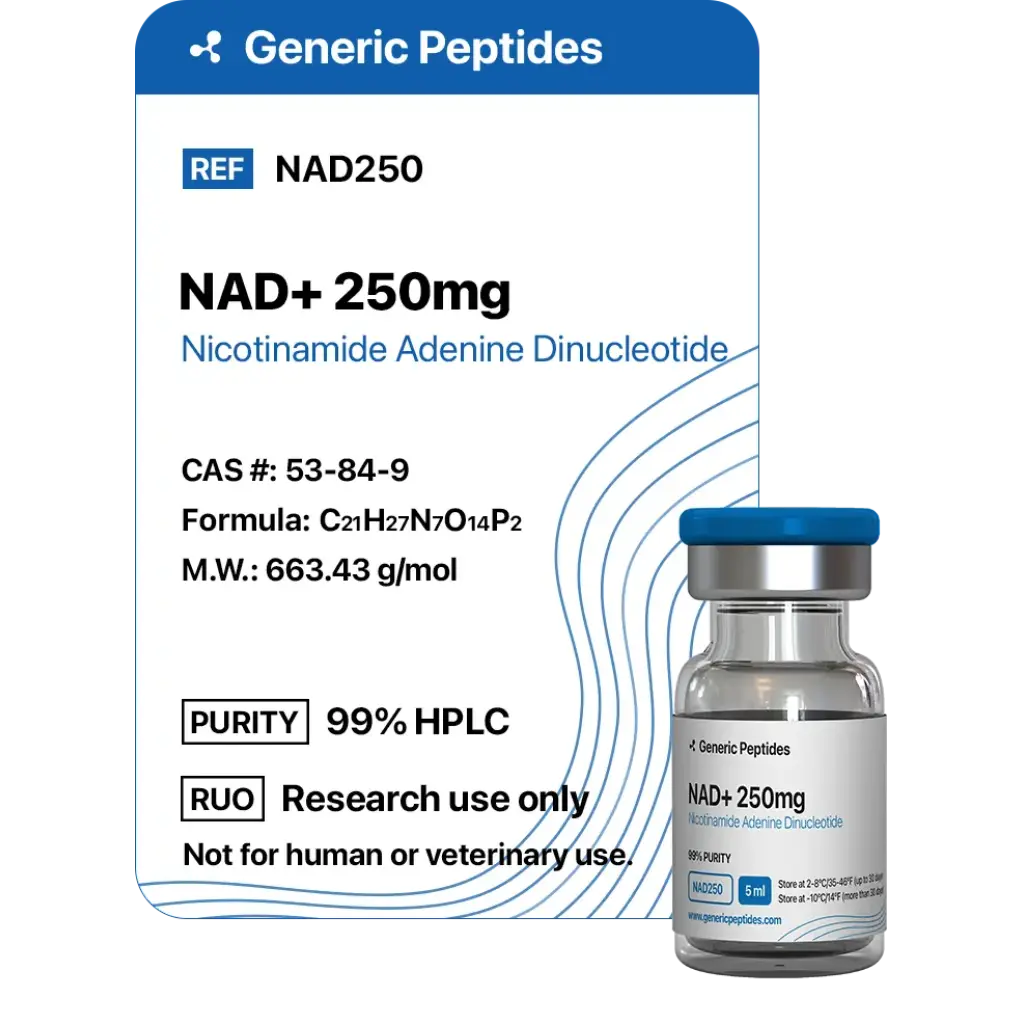
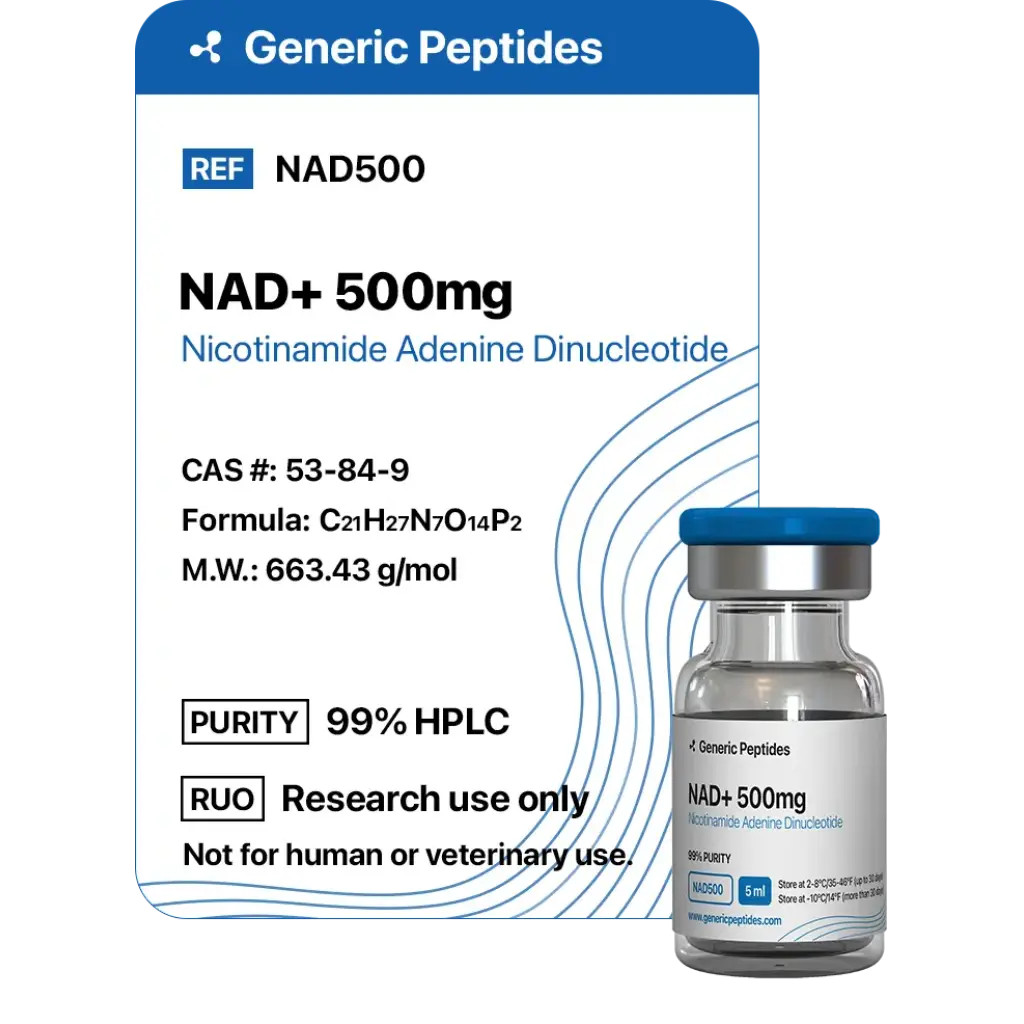
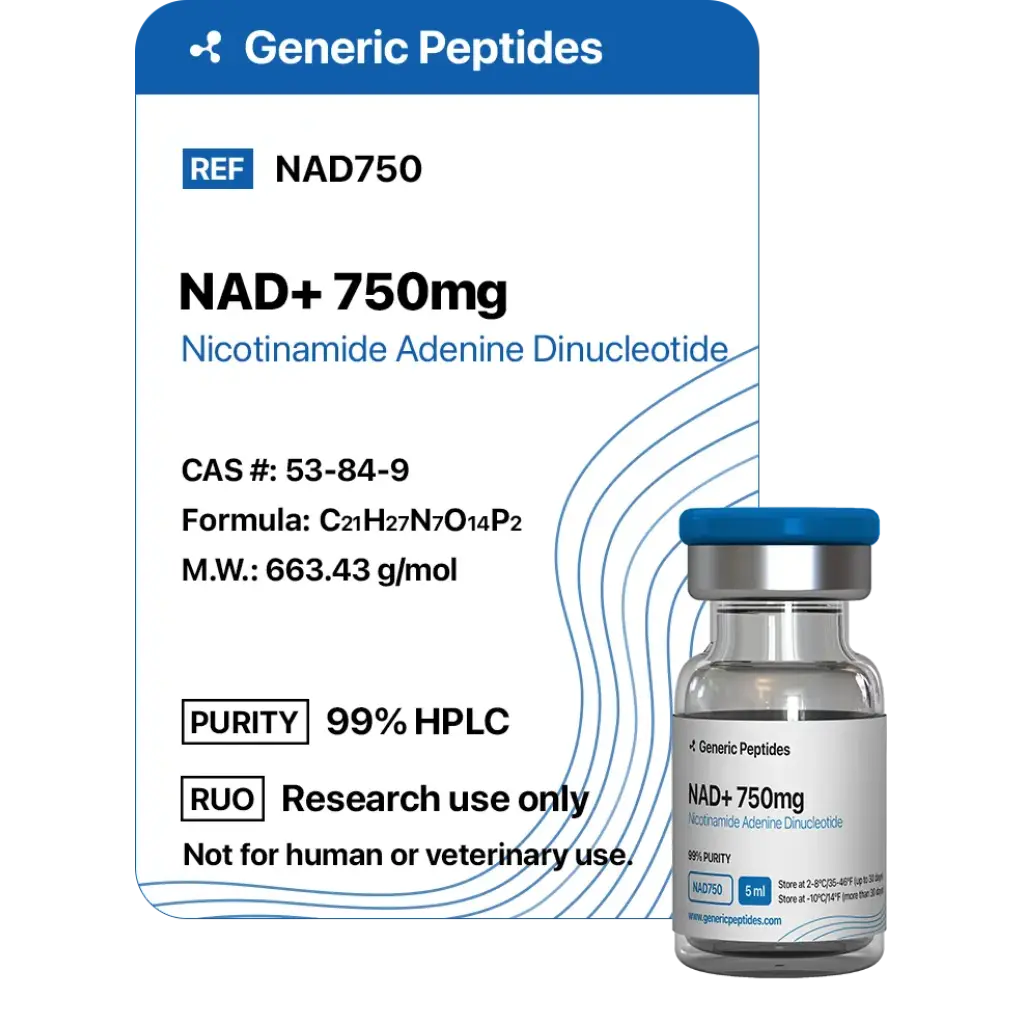
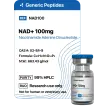
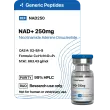
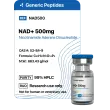
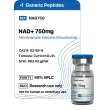
Generic Peptides
Estimated Delivery: 12-26 Days (International), 3-6 Days (United States)
Return within 45 Days of purchase. Duties & taxes are non-refundable.
Buy NAD+ 100, 250, 500 and 750 mg vials by Generic Peptides at XSteroids. NAD+ is not a peptide even though it shares this catalog: its full name is nicotinamide adenine dinucleotide, the coenzyme that carries electrons in every living cell. The catalog carries it as a lyophilized powder prepared for laboratory work. Below you will find the chemistry, the two jobs the coenzyme performs inside a cell, what the infusion literature actually measured, the strength math for each vial size, and the shelf life and legal picture.
No regulator anywhere has approved NAD+ for a clinical indication. Wellness clinics present intravenous NAD+ as a service, yet offering a service is not the same as holding an approval, and the powder offered here is bench material rather than a medicine.
NAD+ is a dinucleotide built from nicotinamide and adenine, with a molar mass around 664 g/mol in its oxidized form. It exists in every living cell and shuttles between two states: NAD+, which accepts electrons, and NADH, which carries them. That cycle is central to how mitochondria produce ATP, which is why NAD+ is described as an energy coenzyme rather than a drug.
One glass vial of white lyophilized powder arrives in the strength you pick - 100 mg, 250 mg, 500 mg or 750 mg. Water for mixing has to be sourced on its own. Generic Peptides publishes neither a filler nor an excipient list for these vials, and no outside laboratory has confirmed the stated mass, so nothing here goes beyond the supplier label.
The first job of NAD+ is redox chemistry. It accepts a hydride ion and becomes NADH, then hands those electrons to the mitochondrial electron transport chain, where they drive the proton gradient that makes ATP. Without a working NAD+ pool, oxidative energy production stalls, which is why the molecule is studied in models of fatigue and metabolic stress rather than as a receptor drug.
The second job is less familiar. NAD+ is consumed as a substrate by two large enzyme families: the sirtuins, which are NAD-dependent deacetylases linked in the literature to stress response and aging, and PARP, which is recruited to sites of DNA damage. Both reactions break NAD+ down, so the cell has to keep rebuilding its supply. It does that through the salvage pathway from nicotinamide and NMN. Cell and tissue levels of NAD+ fall with age, and that decline is linked in the sources to weaker repair capacity.
Pharmacokinetics matter here. NAD+ is a charged dinucleotide, so it is not absorbed well by mouth and crosses cell membranes poorly. Human data comes from intravenous infusion, where hundreds of milligrams are given slowly over one or several hours. That route is not equivalent to a subcutaneous injection with a small vial, and nothing in the infusion studies establishes a safe or effective amount for self-administration.
Research interest splits into two lines. The metabolic line asks whether a higher NAD+ pool supports ATP production in models of energy stress. The sirtuin and PARP line treats the coenzyme as raw material for enzymes tied to repair and inflammation. Both lines are largely preclinical, so there is no human dose-response curve to quote.
The one human setting with published numbers is tolerability, not efficacy. A retrospective pilot in 2026 compared intravenous NAD+ with nicotinamide riboside and reported that moderate and severe symptoms lengthened an infusion to an average of about 97 minutes, against about 37 minutes for the comparison arm. That tells you how the infusions felt, not what they achieved. Consumer claims about energy, skin or lifespan are marketing claims, and the published literature does not support them as outcomes.
Figure the strength of the solution first, then read the barrel. The powder mass in milligrams over the water volume in millilitres gives mg per ml. A U-100 insulin syringe marks 0.01 ml for every unit. Put 2 ml into the 100 mg vial and the result is 50 mg per ml, so a draw of 0.1 ml carries 5 mg, which shows as 10 units. The 250 mg vial with 5 ml lands on the same 50 mg per ml. Use 5 ml in the 500 mg vial for 100 mg per ml, where 0.1 ml carries 10 mg and the barrel again shows 10 units, and use 5 ml in the 750 mg vial for 150 mg per ml, where 0.1 ml carries 15 mg.
Swirl the vial until the powder dissolves and keep the solution cold. Because the same 0.1 ml means a different milligram figure in every scenario, write the concentration on the label before the vial goes into the fridge.
NAD+ is usually discussed as a support item rather than a primary compound. Glutathione 200 and 500 mg is the other antioxidant vial in the catalog, Epitalon 10 and 50 mg is the peptide most often grouped with it in longevity write-ups, and 5-Amino-1MQ 10 and 50 mg targets metabolic research from another angle.
For the sleep and cognitive side, DSIP 2 and 5 mg and Semax 2 and 5 mg are the neighbors, and Thymosin Alpha-1 2 to 15 mg covers the immune line. No approval covers any of these pairings; they are simply the vials that research write-ups place next to NAD+.
NAD+ leaves the androgen axis untouched; post-cycle therapy plays no part here, and nothing in the vial is a hormone that suppresses production. If it is added to a laboratory plan, the practical question is tolerance rather than recovery. Because the reported reactions are tied to how fast the material enters circulation, any bench work that measures response should also record the rate of administration, otherwise the result cannot be compared with the infusion literature.
Reported reactions around NAD+ administration are flushing, a sense of tightness or heaviness in the chest, nausea, headache, fatigue and tenderness at the injection site. In the published accounts these are described as rate-related: they appear when the material is pushed quickly and ease when the infusion is slowed. There is very little direct safety data on repeated subcutaneous injections, and this page does not pretend otherwise.
Keep the dry powder at 2 to 8 C, out of direct light, and a freezer is acceptable for longer storage. A mixed solution stays at 2 to 8 C and is used inside 28 to 30 days, never frozen. Throw out a solution that turns cloudy or shows particles.
NAD+ is not named on the WADA Prohibited List, but that is not the same as being allowed: class S0 already covers unapproved substances used to enhance performance. The vial on this page is a research product with no approved indication, and it is sold for laboratory work, not for human use.
Order NAD+ from the Generic Peptides brand catalog at XSteroids. Every vial size lives on a single page, payment runs through a protected checkout, domestic parcels reach US addresses in 3 to 6 days, and international ones take 12 to 26 days. The cards underneath list the longevity and immune partners, so one order can stock a whole bench.
No. NAD+ is nicotinamide adenine dinucleotide, a coenzyme built from nicotinamide and adenine with a molar mass near 664 g/mol. It is grouped with peptides in this catalog only because both are lyophilized research vials. Its job in the cell is moving electrons between NAD+ and NADH.
Two reasons. The redox cycle between NAD+ and NADH is central to ATP production, and NAD+ is also consumed as a substrate by sirtuins and by PARP, enzymes tied to repair and inflammation. Cell levels of NAD+ fall with age, which is where most of the interest comes from.
Divide the milligrams by the millilitres of bacteriostatic water. A 100 mg vial with 2 ml gives 50 mg per ml, so 0.1 ml holds 5 mg and reads as 10 units on a U-100 syringe. A 500 mg vial with 5 ml gives 100 mg per ml. Swirl gently, never shake.
Flushing and warmth, chest tightness or pressure, nausea, headache, fatigue and injection site soreness. They follow the speed of administration rather than the dose: a 2026 clinic pilot saw moderate to severe symptoms stretch infusion times to about 97 minutes against 37 minutes for nicotinamide riboside. Slower delivery reduces them.
No. NAD+ has no approved indication anywhere. Clinics market intravenous NAD+ as a wellness service, but that does not make it an approved drug or an approved use. The vial sold here is a research product for laboratory work, not a treatment, and no dose has been established for human use.
Store the lyophilized powder at 2 to 8 C away from light, and use a freezer only if you are keeping the powder long term. After mixing, keep the solution at 2 to 8 C and use it within 28 to 30 days. Never freeze a reconstituted solution, and discard it if it turns cloudy.
You can buy NAD+ by Generic Peptides online at XSteroids, direct from the brand catalog. Pick the 100, 250, 500 or 750 mg vial on this page and check out securely. US domestic shipping takes 3 to 6 days and international delivery 12 to 26 days.
Loading...
Your cart is currently empty. Let us assist you in finding the right product