Quick View
Loading...

Xeno Laboratories
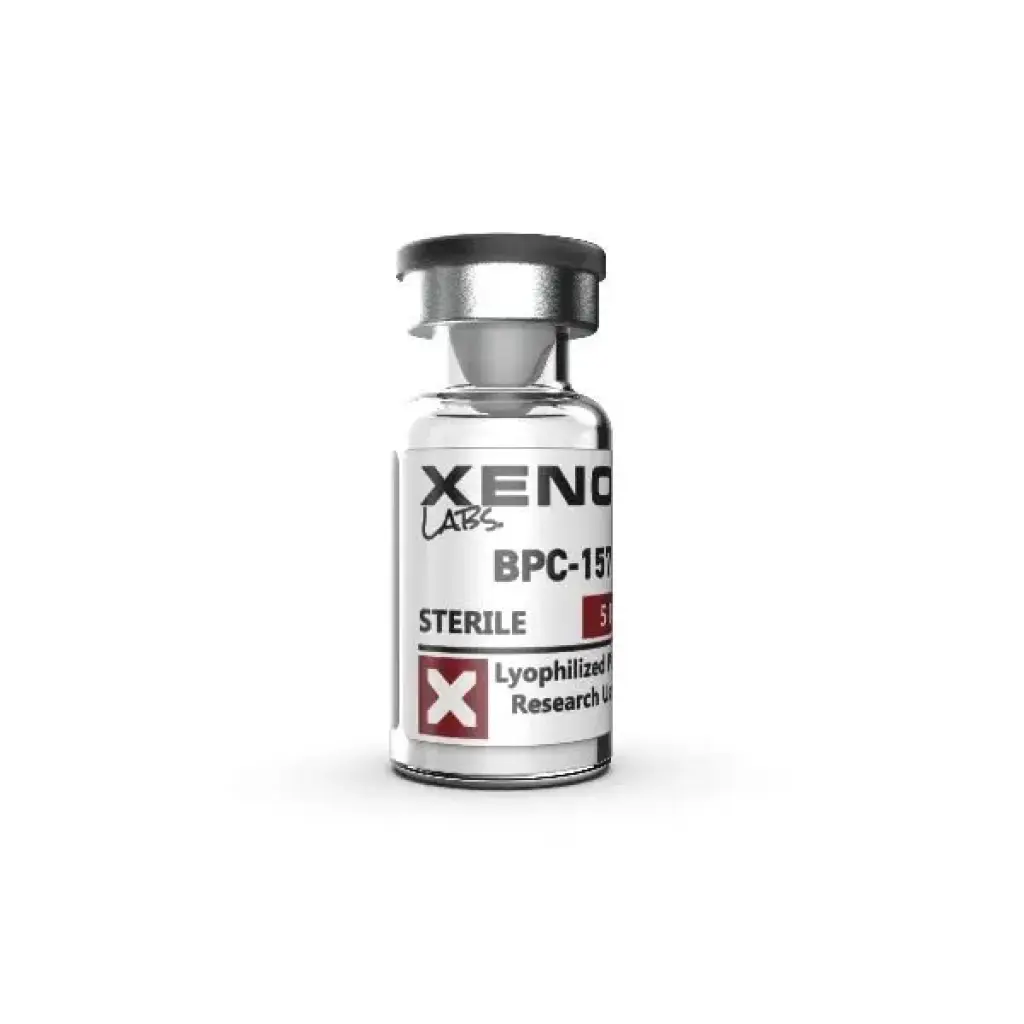
Buy BPC-157 by Xeno Labs at XSteroids. BPC-157 is the synthetic pentadecapeptide that the research literature calls Body Protection Compound 157, and Xeno Labs ships it as a lyophilised powder in a single glass vial. This page sets out what the vial is, how the peptide behaves in animal studies, what the published doses look like, how to mix the powder and read a U-100 syringe, and where the legal and anti-doping lines sit.
Two caveats shape everything that follows. There is no licensed medicine form of BPC-157, and the compound appears in the WADA S0 category as an illustration of a substance with no medical use. None of the material below is clinical advice; every number is taken from research papers and none of it is a programme for a human being.
What arrives is a single small glass vial of white lyophilised powder. The peptide name sits on the pack, and the product is filed in the repair peptide category beside the cognitive and longevity vials of the same line. No filler list accompanies it, no third party assay of the contents has ever been published, and only one strength is catalogued, so the shop page reproduces the label as written instead of asserting a verified mass.
The molecule itself is a short chain of fifteen amino acids, sequence Gly-Glu-Pro-Pro-Pro-Gly-Lys-Pro-Ala-Asp-Asp-Ala-Gly-Leu-Val, formula C62H98N16O22 and a mass of about 1419.56 g/mol. It is a fragment of a protein found in gastric juice, not a steroid, not a hormone and not a growth factor: it is a peptide, and it has to be dissolved before any research use.
The consistent findings in animal work are cytoprotection, faster healing of experimental tissue injuries, new blood vessel formation and a drop in pro-inflammatory cytokines. Several papers also describe increased expression of the growth hormone receptor and of signalling paths tied to angiogenesis. Those effects were recorded in rats, mice and, in pharmacokinetic work, dogs.
Pharmacokinetics in animals move quickly. After intramuscular and intravenous dosing in rats, the reported half-life falls between 7.9 and 30 minutes, while absolute intramuscular bioavailability came out at 45 to 51 percent in dogs and 14 to 19 percent in rats, with urine and bile clearing the peptide. Stability is the surprise: a molecule this small survives human gastric juice intact for over a day and remains stable in urine for four days, which is why the literature keeps returning to the oral versus injection question.
Expect a short-lived compound. With a half-life measured in minutes, single-dose blood levels clear long before the day is over, and the animal studies that report tissue effects used repeated administration over days or weeks, not one shot. A single injection will not hold a level.
Expect the evidence to be preclinical. A systematic review screened 544 papers and included 36 studies: 35 of them were animal or laboratory work and only one was a clinical study. For a buyer that matters more than any single headline result, because the human safety profile has not been characterised in the way a licensed medicine is.
The arithmetic is the same for every lyophilised peptide. Concentration equals the milligrams in the vial divided by the millilitres of water added, and one unit on an insulin syringe marked U-100 is 0.01 ml. Choose the water volume so that the reading on the syringe lands on a comfortable mark.
A 5 mg vial with 2 ml of bacteriostatic water gives 2.5 mg/ml, so 0.1 ml is 250 mcg and reads as 10 units. The same 5 mg with 5 ml gives 1 mg/ml, so 0.1 ml is 100 mcg and reads as 10 units. A 10 mg vial with 2 ml gives 5 mg/ml, so 0.1 ml is 500 mcg and reads as 10 units. The strength of this Xeno vial is printed on the pack; use that number in the same formula.
Published animal work uses microgram amounts per kilogram, which is why low microgram readings are normal in this field. Higher numbers are not better: the studies that report effects report repeated small doses.
In the literature the peptide is usually studied alone. Buyers often pair it with other repair work: Semax for the neurological side of recovery research and Selank for the calm-focus side. Longevity work is covered by Epitalon, and the metabolic pair of Semaglutide and Tirzepatide is the third shelf of the same catalog.
Hormonal recovery is separate. Where a cycle has suppressed natural production, HCG 5000 IU and HMG 75 IU belong to that discussion, and Tamox belongs to the SERM side of it. Nothing in this paragraph is a recommendation to combine anything.
Because human pharmacokinetics are not established, there is no validated washout figure to quote. The practical research approach is to treat each vial as one short block, keep notes on what was given and when, and leave a gap between blocks rather than running one continuously.
Recovery in this context means the body's own healing, not restarting a suppressed axis: BPC-157 is not suppressive and does not require a post-cycle protocol. If a research block sits inside a steroid cycle, the recovery plan is about the steroids, and the SERM and HCG cards in this catalog cover that side.
There is no human safety dataset large enough to describe a side effect profile, because there is almost no human data at all. Reported animal findings are generally uneventful, but absent human data is not the same as a clean record, and the 2025 review that examined the evidence base pointed at exactly that gap.
Regulatory status is the hard line: there is no licensed medicine form of it. Anti-doping status is equally clear: the peptide has been prohibited since 2022 under the WADA S0 class, the catch-all category, and the 2026 list names BPC-157 as an example. A therapeutic use exemption is unrealistic for a substance with no licensed indication. This vial is a research product only.
The dry vial wants either refrigeration at 2 to 8 C or a stable room temperature between 15 and 25 C, always shielded from light, and the powder itself must never enter a freezer. After water is added the solution belongs in the fridge and should be finished inside 28 to 30 days, with freeze-thaw cycles avoided because each one damages peptide. Store it standing upright, somewhere nobody could take it for ordinary medicine.
This vial occupies one page of the Xeno Labs catalog at XSteroids, and every other shelf of the line sits behind it, so a single order can gather the repair, cognitive, longevity and metabolic entries at once. Payment goes through an encrypted checkout; a US parcel typically lands within 3 to 6 days and an international shipment within 12 to 26. Cards below list what buyers usually add alongside it.
It is a single glass vial of lyophilised BPC-157, the synthetic pentadecapeptide also called Body Protection Compound 157, with fifteen amino acids and a mass of about 1419.56 g/mol. Xeno Labs prints the peptide name and the strength on the pack. No filler list and no independent potency test for this vial have been published.
No. There is no licensed medicine form of it in any country, and a 2025 review tied that to the shortage of clinical research. A systematic review of the field found 36 eligible studies, of which 35 were preclinical and only one was a clinical study. This vial is a research product.
Animal research uses microgram amounts per kilogram, repeated over days or weeks. The half-life reported in rats is 7.9 to 30 minutes after intravenous or intramuscular dosing, so one administration cannot hold a level. Human dosing has never been established, which is why no human amount can be quoted as correct.
Add bacteriostatic water, then divide the milligrams in the vial by the millilitres added. A 5 mg vial with 2 ml gives 2.5 mg/ml, so 0.1 ml is 250 mcg and reads as 10 units on a U-100 syringe. One unit equals 0.01 ml. Substitute the strength printed on your pack.
Store the reconstituted solution at 2 to 8 C and use it within 28 to 30 days. Do not freeze it, and avoid freeze-thaw cycles, because repeated temperature swings degrade peptides. The dry powder is more forgiving: 2 to 8 C, or 15 to 25 C away from light, and never frozen.
Yes. BPC-157 has been prohibited since 2022 under the WADA S0 class, the catch-all category, and the 2026 prohibited list names it as an example in that class. The category applies at all times, in and out of competition, and a therapeutic use exemption is unrealistic without a licensed medical indication.
You can buy the Xeno Labs BPC-157 vial online at XSteroids, direct from the brand catalog. Add the vial to the cart on this page and check out securely. US domestic shipping takes 3 to 6 days and international delivery 12 to 26 days.
Loading...
Your cart is currently empty. Let us assist you in finding the right product