Quick View
Loading...

Xeno Laboratories
Buy Tirzepatide by Xeno Labs at XSteroids. Tirzepatide is the twin incretin agonist marketed as Mounjaro for type 2 diabetes and as Zepbound for weight management, and Xeno Labs offers the same peptide as a freeze dried powder in one glass vial. What follows sets out what the vial holds, repeats the trial figures, explains how the powder is dissolved and drawn on a U-100 syringe, and states the anti-doping position without embellishment.
Start with the format. A single glass vial holds the peptide as a white freeze dried powder, which is dissolved in bacteriostatic water and drawn on a U-100 syringe when a study calls for it. The clinical numbers quoted later come from trials of the same molecule given as a weekly injection, and they belong to that context. Nothing on this page is medical advice.
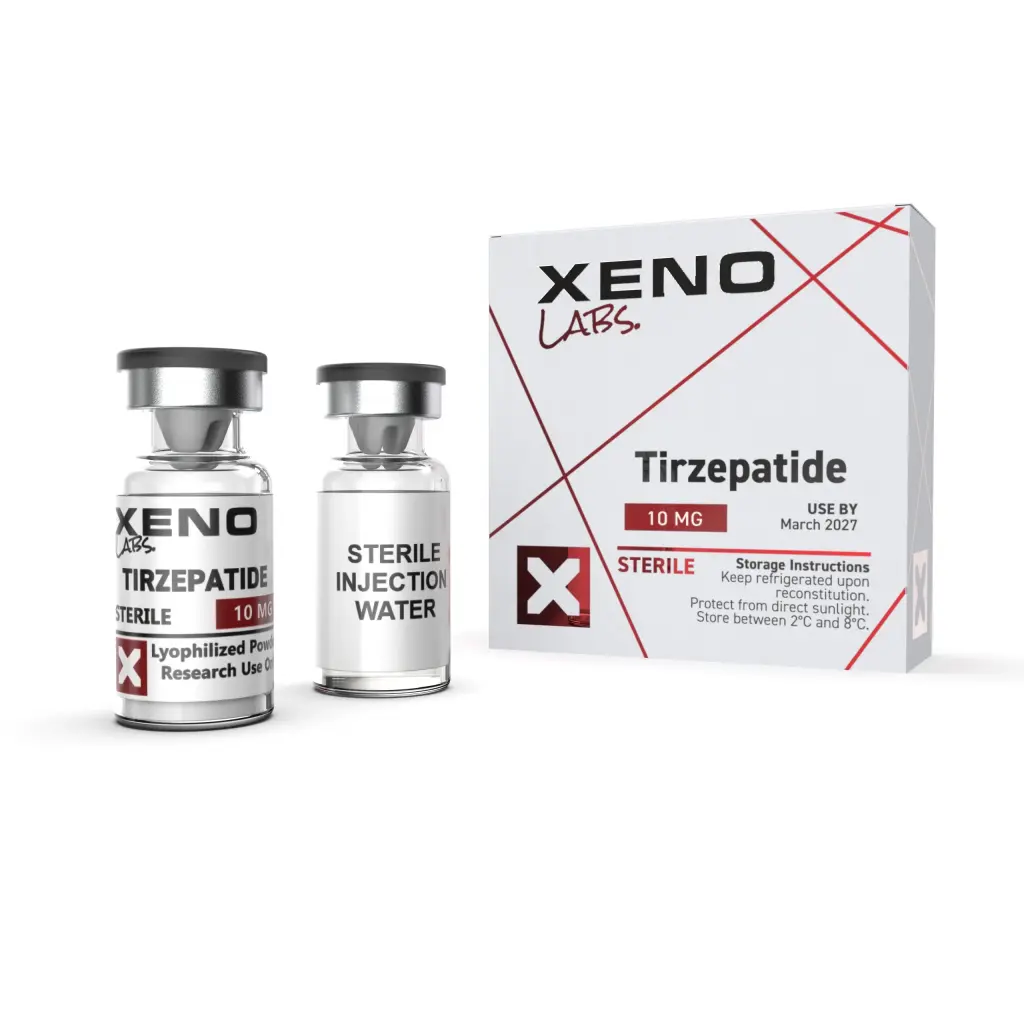
The order contains a single glass vial holding a white freeze dried powder, shelved in the metabolic corner of the Xeno Labs line next to Semaglutide. Tirzepatide is a straight chain peptide of 39 amino acids, an analogue of human GIP carrying a C20 fatty diacid attached through a linker, and that lipid tail is what anchors it to albumin and holds it active for days instead of minutes.
The box carries the peptide name and the printed strength, applied by Xeno Labs. There is no declared list of excipients, no outside potency result for this particular vial has ever been filed, and no dosing chart travels with it. Until the material is physically in front of you, treat the printed pack as the only specification.
This is the point that separates tirzepatide from a plain GLP-1 peptide: it is an agonist at both the GIP receptor and the GLP-1 receptor, with higher affinity reported at GIP. Activating two receptors instead of one amplifies glucose-dependent insulin secretion, slows gastric emptying and reduces food intake, which is why the class comparison tables usually place it ahead of mono-agonists on weight change.
As a long-acting peptide its elimination half-life runs to roughly five or six days, which is why any sensible ramp holds each step for about four weeks before moving up. A vial that you mix yourself is a different creature altogether: no human pharmacokinetic profile has been published for it, and the clearance curve of the clinical injection does not automatically belong to a powder reconstituted at home.
Expect slow accumulation and a slow decay. With a peptide half-life measured in days, a weekly schedule builds up over a month and fades over roughly the same period after the last dose, which is why single administrations in the trials produced only a fraction of the final result.
Expect gastrointestinal tolerance to be the limiting factor, not the theoretical potency. In every trial the dose had to be climbed in steps precisely because nausea and abdominal discomfort appear at the point of each increase. Expect the effect on weight to reverse when dosing stops: the withdrawal trial showed roughly 14 percent of body mass returning within a year off treatment.
The arithmetic behind every dilution is fixed: take the number of milligrams in the vial and divide it by the number of millilitres of bacteriostatic water you added, which gives the strength per millilitre. On a U-100 barrel, a single unit is 0.01 ml. Trickle the water down the inner wall, swirl the vial instead of shaking it, and give the powder time to dissolve.
Dilute a 5 mg vial with 1 ml of water and you hold 5 mg/ml, which makes the 2.5 mg starting quantity 0.5 ml, or 50 units on the barrel, while 1 mg comes to 20 units. Dilute a 10 mg vial with the same 1 ml and the strength doubles to 10 mg/ml, so 2.5 mg draws 0.25 ml, or 25 units, and 5 mg draws 50 units. A 2 mg vial simply cannot deliver 2.5 mg in a sensible volume, because that figure is 1.25 ml at 2 mg/ml. Always work from the strength printed on your Xeno pack.
Mounjaro starts at 2.5 mg weekly, rising by 2.5 mg no more often than every four weeks, with 15 mg weekly as the adult maximum. Zepbound also starts at 2.5 mg weekly for four weeks, a step that is explicitly not a maintenance dose, then rises every four weeks or more, to 5, 10 or 15 mg weekly, and 10 or 15 mg where sleep apnoea is the indication. A 5 mg vial holds two weeks of the starting dose and does not reproduce a maintenance course: that is the arithmetic of a research pack.
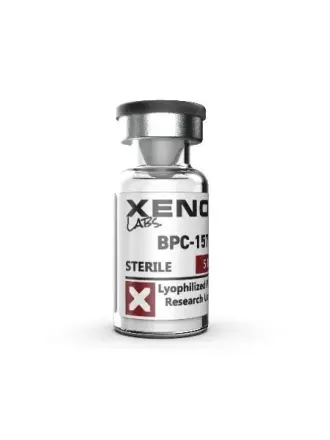
No combination is suggested here; this is what the same catalog offers. The direct comparator is Semaglutide. Repair and joint research uses BPC-157, and the longevity and cognitive cards are Epitalon, Semax and Selank.
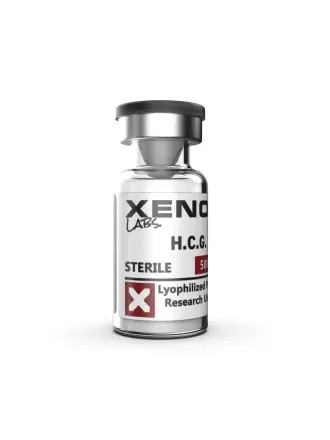
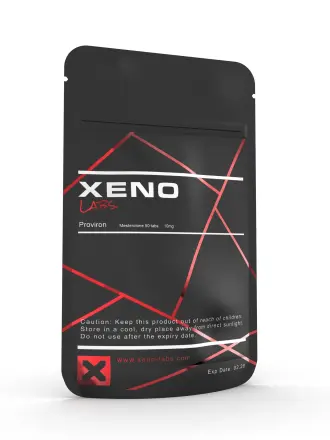
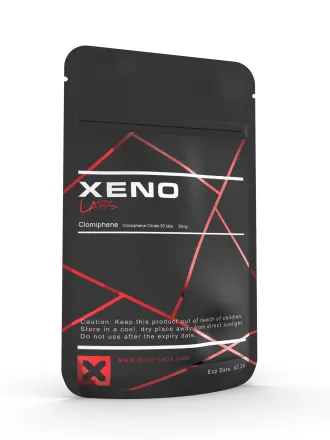
If the person is also running a hormonal cycle, the recovery shelf is separate: HCG 5000 IU, HMG 75IU, the SERM cards Tamox and Clomiphene, and Proviron for support work. An incretin peptide does not interact with any of them in a way that makes it a required addition.
SURMOUNT-4 was built to answer exactly this. After an open-label phase, participants were randomised to continue tirzepatide or switch to placebo for 52 weeks. The placebo group regained about 14 percent of body mass, while those who continued lost a further 5.5 percent, a gap of roughly 19 percentage points between the arms.
A post hoc look at the same data found that most people who stopped regained more than a quarter of what they had lost. For a research vial the caveat is that no withdrawal study has ever been run on a reconstituted product; the trial data come from clinical injections with a known delivered dose.
The gastrointestinal list is the same as the rest of the class: nausea, vomiting, diarrhoea, constipation and upper abdominal discomfort, appearing most often at each dose increase and easing afterwards. In the label data gastrointestinal reactions were reported in roughly 56 percent of treated participants against 30 percent on placebo, and 5 to 7 percent discontinued because of them.
The label carries a boxed warning about thyroid C-cell tumours seen in rodents, and it rules out use where medullary thyroid cancer or MEN-2 runs in the family; warnings about pancreatitis across the whole class were tightened during 2026. Where sport is concerned, the GLP-1 class is not prohibited and no therapeutic use exemption is needed, though it does sit inside the WADA monitoring programme. The item sold on this page is a research preparation packed for laboratory work, and the figures above describe the molecule rather than a ready made device.
Keep the powder vial either chilled between 2 and 8 C or at room temperature between 15 and 25 C, always shielded from light, and never let the dry powder freeze. Once it has been mixed, hold the liquid between 2 and 8 C and finish it inside 28 to 30 days, steering clear of repeated freezing and thawing. Write the mixing date on the vial so the window is not lost.
This tirzepatide card belongs to the Xeno Labs brand catalog at XSteroids, and the metabolic vials can be bought together with the repair, longevity and support shelves of the same line. Checkout is encrypted; orders inside the United States arrive in 3 to 6 days, and parcels sent abroad reach their destination in 12 to 26 days. The related cards below show the standard comparisons.
It is a dual agonist, not a mono-agonist. Tirzepatide is a 39 amino acid analog of human GIP that also activates the GLP-1 receptor, and its reported affinity is higher at the GIP receptor. Semaglutide, by contrast, acts at the GLP-1 receptor alone, which is the usual basis for comparing the two.
The molecule is the same, the product is not. Mounjaro and Zepbound are single dose pens built for a set weekly routine; this Xeno Labs vial is a lyophilised research powder that you dissolve and measure yourself. What carries across is the pharmacology of a dual incretin agonist, not a prepared device with a printed schedule.
SURMOUNT-1 followed 2539 adults with obesity but without diabetes for 72 weeks. Mean weight change was minus 15.0 percent at 5 mg, minus 19.5 percent at 10 mg and minus 20.9 percent at 15 mg weekly, against minus 3.1 percent on placebo. Those are results for a clinical injection, not for a research vial.
Two. The clinical starting point is 2.5 mg weekly, and a 5 mg vial mixed with 1 ml of bacteriostatic water gives 5 mg/ml, so 2.5 mg is 0.5 ml and reads as 50 units on a U-100 syringe. That covers two weeks, not a titration course, and a research vial follows no fixed schedule of its own.
Weight returns. In SURMOUNT-4 participants switched to placebo regained about 14 percent of body mass over 52 weeks, while those who continued lost roughly 5.5 percent more, a gap near 19 percentage points. A post hoc analysis found most who stopped recovered more than a quarter of the weight they had lost.
No. Tirzepatide is not named on the WADA prohibited list and a therapeutic use exemption is not required. The GLP-1 and dual agonist class is included in the WADA monitoring programme, which means data are being collected and the classification could change in a later edition of the list.
You can buy the Xeno Labs tirzepatide vial online at XSteroids, direct from the brand catalog. Add the vial to the cart on this page and check out securely. US domestic shipping takes 3 to 6 days and international delivery 12 to 26 days.
Loading...
Your cart is currently empty. Let us assist you in finding the right product