Quick View
Loading...

Generic Peptides
Estimated Delivery: 12-26 Days (International), 3-6 Days (United States)
Return within 45 Days of purchase. Duties & taxes are non-refundable.
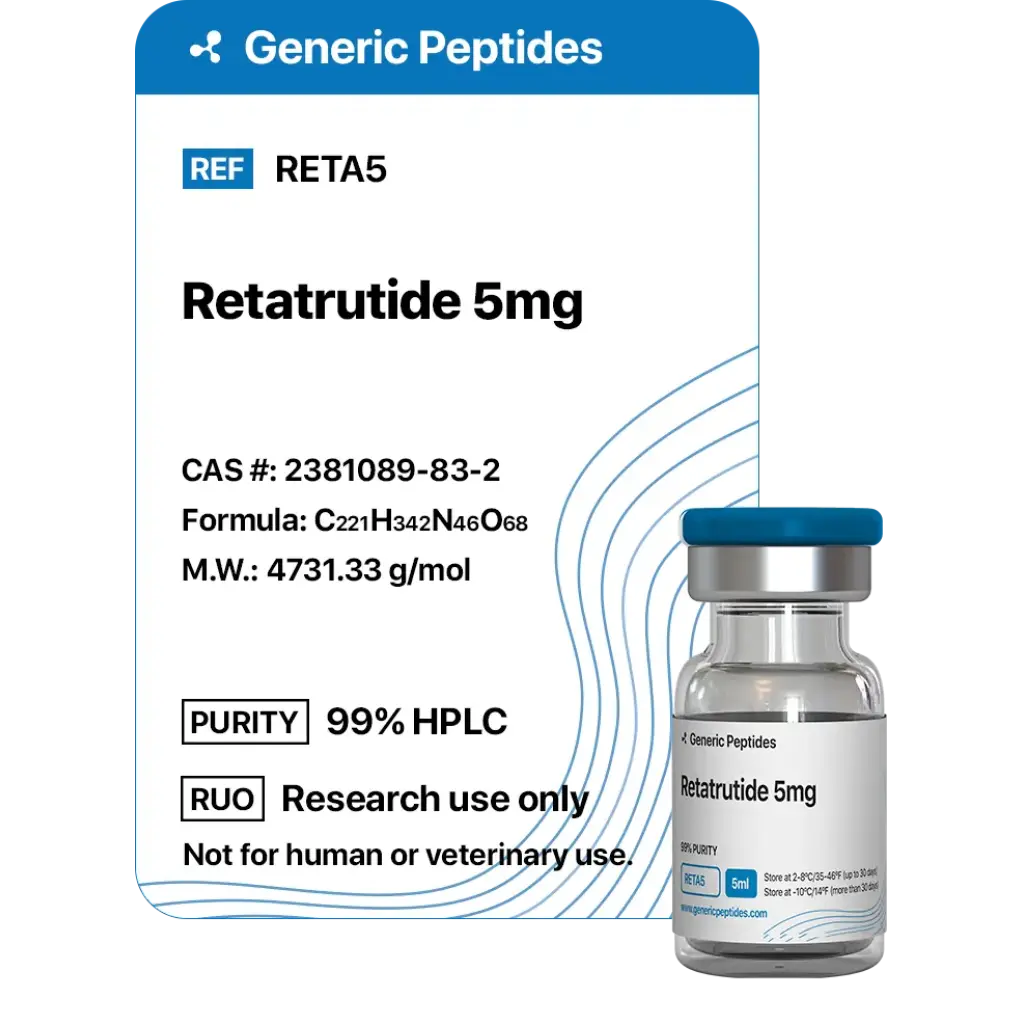
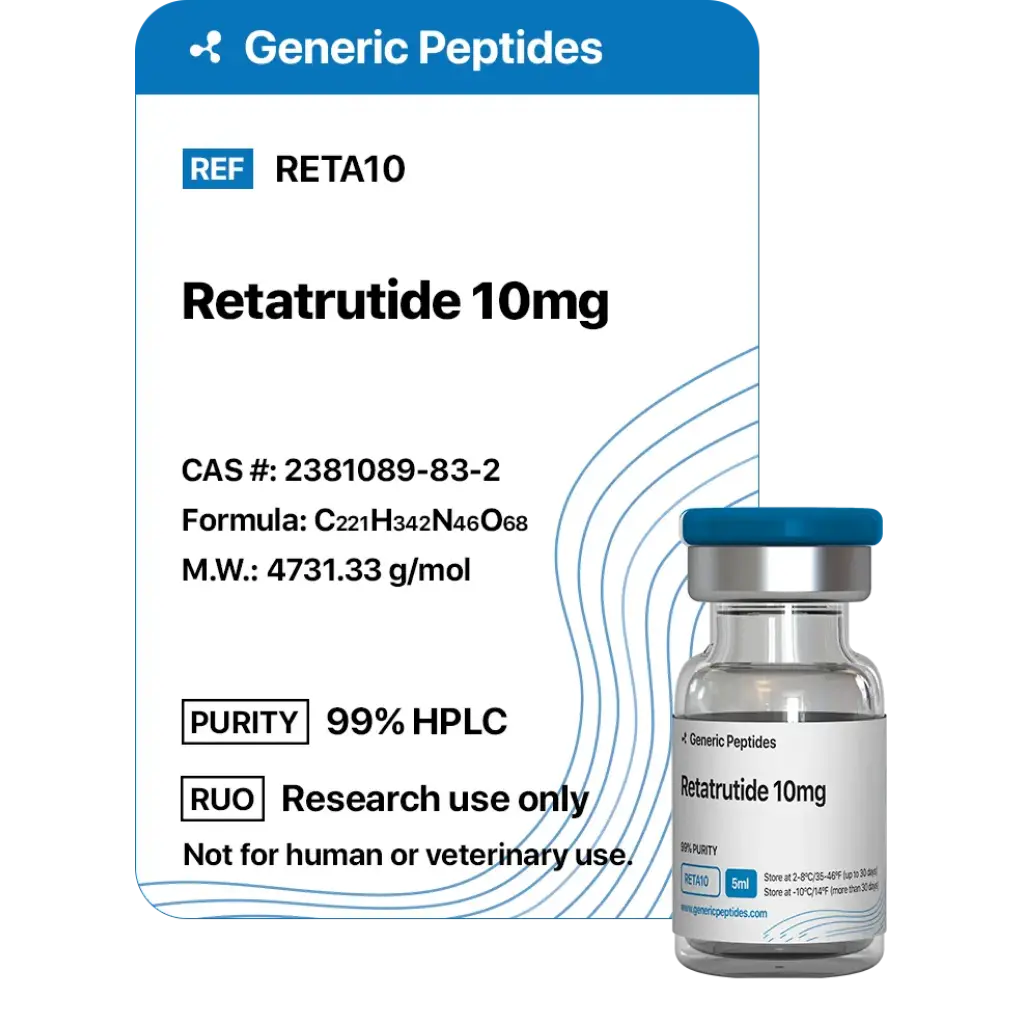
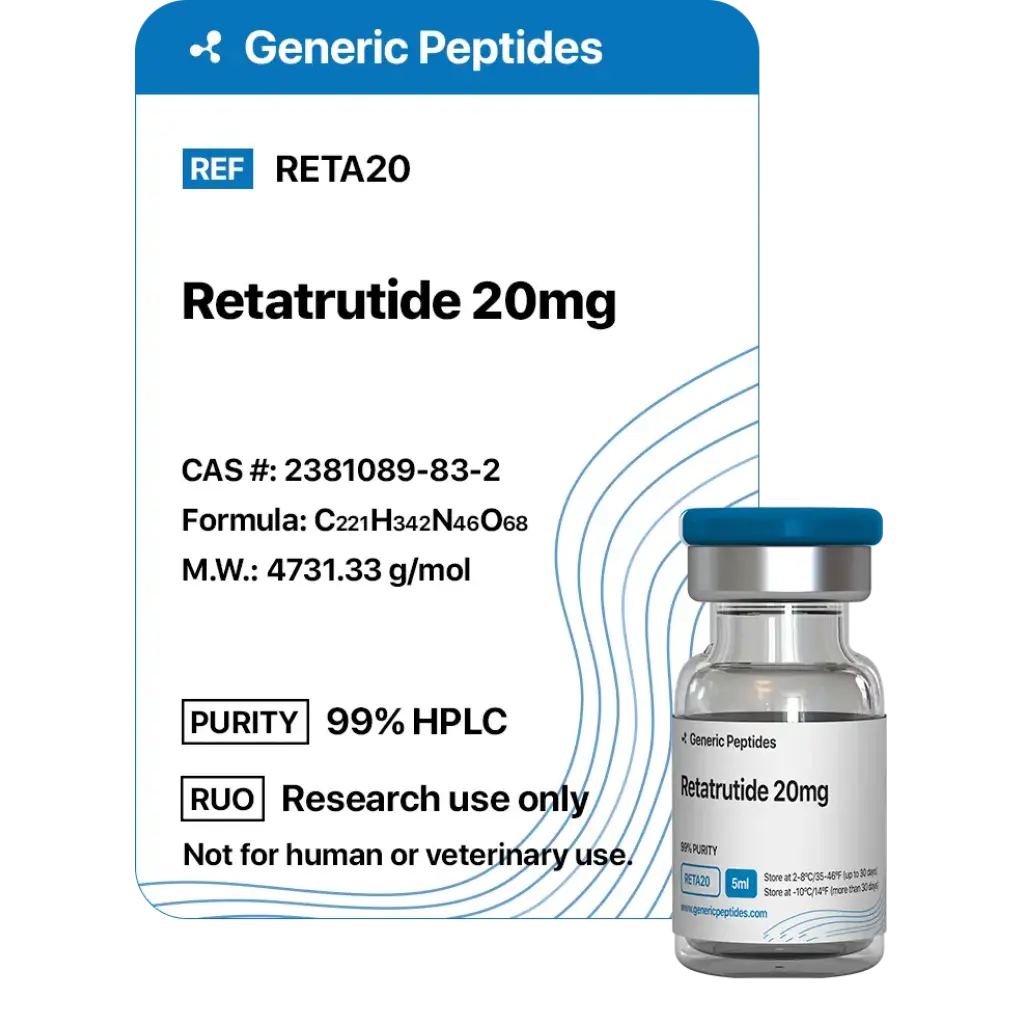
Buy Retatrutide by Generic Peptides at XSteroids. Retatrutide is a triple agonist still under investigation: it engages the GLP-1, GIP and glucagon receptors together. Generic Peptides supplies it as a lyophilized powder in 5 mg, 10 mg and 20 mg vials. Below you will find what the molecule is, where the human data currently stands, how each vial size works out on a syringe, and what remains genuinely unknown.
Unlike semaglutide and tirzepatide, this one has no approved form anywhere in the world. It exists only as an experimental molecule, so the vial on this page is research material and nothing here is a treatment recommendation.
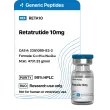
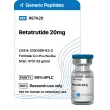
Retatrutide ships as one glass vial of white lyophilized powder in 5 mg, 10 mg or 20 mg, and whichever option is chosen is the whole content of that vial. Diluent is not part of the order. The powder is dissolved before laboratory work, and the pack listing here is the only supplier documentation: no filler breakdown and no third party potency result are published.
The molecule, known during development as LY3437943, is a synthetic peptide built to activate three receptors: GLP-1, GIP and glucagon. The design target was a once-weekly subcutaneous injection, and the studies that followed recruited mostly adults carrying obesity or type 2 diabetes. A lipid chain on the molecule lets it bind albumin, which is what keeps it active for about a week. What you are buying is that molecule in a research format, with no approved indication and no approved dose anywhere.
Three receptors mean three signals running together. The GLP-1 and GIP arms slow gastric emptying, support glucose-dependent insulin release and reduce appetite, in the same way the better known incretins do. The glucagon arm is the difference: glucagon receptor activation raises energy expenditure, which is one reason the weight changes in the trials exceeded what the dual agonists produced.
The combination also explains why the tolerability profile is dominated by gastrointestinal effects that grow with dose and peak while the dose is being increased.
Trial protocols used one injection per week, with the dose raised in steps of roughly four weeks. That rhythm belongs to study design rather than to an approved label, since no label for the molecule exists. No consumer dose can be derived from the published half-life data, and the accumulation reported in the trials matches the albumin binding of the molecule.
All of the useful evidence is trial data, and the studies are ongoing. In a phase 2 study of adults with obesity, average weight fell by about 22.8 percent at 8 mg and 24.2 percent at 12 mg over 48 weeks. In the phase 3 obesity programme, the TRIUMPH-1 trial reported about 19 percent loss at 4 mg, 25.9 percent at 9 mg and 28.3 percent at 12 mg over 80 weeks, against 2.2 percent on placebo, and at the top dose roughly 45 percent of participants lost at least 30 percent of body weight.
Those figures describe study arms with a lifestyle programme, not a promise for a vial, and they are the highest of the incretin class so far. The honest caveats are that the molecule is still investigational, the long term safety record is incomplete, and there is no withdrawal study of the kind that exists for the approved drugs.
Because the molecule is still in trials, there is no formal post-withdrawal dataset. What the class shows is that weight regain follows withdrawal as a rule, and the developers have not yet published a stopping study for retatrutide. Anyone treating the trial weight figures as a permanent result, or as a guarantee, is reading them wrong. The honest position is that long term outcomes are still being collected.
Mixing the 5 mg pack with 2 ml of bacteriostatic water gives 2.5 mg per ml; the 10 mg pack reaches 5 mg per ml and the 20 mg pack 10 mg per ml on the same volume. At 5 mg per ml, 1 mg occupies 0.2 ml, which is 20 units on a U-100 syringe, and 2 mg occupies 40 units. A 5 mg vial mixed with only 1 ml also lands at 5 mg per ml. Introduce the water against the vial wall and rotate gently; peptides are not shaken.
The math is worth doing before ordering. A 10 mg vial supplies ten 1 mg steps, five 2 mg steps or two and a half 4 mg steps. A single 20 mg vial does not cover one weekly 12 mg dose split across the top phase 3 arm, which shows these are research pack sizes rather than a copy of the trial protocol.
The phase 2 study tested 1, 4, 8 and 12 mg weekly, and the phase 3 obesity programme used 4, 9 and 12 mg. Those numbers describe study arms, not a dose for a research vial, and there is no approved titration for the product sold here.
No approved version exists, so there is no established combination schedule, and the trial data was collected on retatrutide alone with a lifestyle programme in every arm. The natural comparisons are Tirzepatide, the approved dual agonist, and the single-receptor Semaglutide. Fat-loss research on the same shelf works through entirely separate routes: HGH Frag 176-191, AOD 9604 and the experimental Adipotide. Metabolic and recovery entries such as Tesamorelin and NAD+ complete that part of the range.
There is no recovery protocol because there is no approved clinical use and no withdrawal study. As with every incretin, appetite and intake return when the signal stops, and the trials do not yet answer how durable the loss is after stopping. Nothing resembling a post-cycle regimen has been validated for retatrutide, and an incretin of this kind leaves the hormonal axis intact in the way anabolic compounds do not. The accurate statement is that long term outcomes are unknown.
Gut complaints top the list in the phase 2 data, with dose as the main driver: nausea, vomiting, diarrhoea, constipation and abdominal discomfort. They clustered around the highest starting dose and settled once titration began from a lower point. Tiredness and headache were reported as well, together with a modest rise in resting heart rate that peaked near week 24 and then came down.
The GLP-1 class carries known risks of pancreatitis, gallbladder disease and gastrointestinal intolerance, but with retatrutide these have not been confirmed in the trials and long term outcomes are still under study. With no approved label there are no established contraindications for this molecule either; the thyroid C-cell caution that applies to the approved incretins is a class note, not a retatrutide label.
Nothing on the WADA prohibited list covers GLP-1 agonists, and no separate anti-doping ruling exists for retatrutide itself. The class is monitored rather than banned, so the accurate statement is that no prohibition is published, which is not the same as being cleared for sport.
With no approved label in existence there is no regulatory standard to follow. The powder holds at 2 to 8 C, and a freezer suits longer holding periods. Dissolved material sits at 2 to 8 C and is used inside about four weeks without ever being frozen. Those are peptide laboratory conventions, not label directions.
Retatrutide from Generic Peptides is supplied as a labelled research vial in 5 mg, 10 mg or 20 mg, matching the pack listing on this page. Payment is encrypted, delivery inside the US runs 3 to 6 days and international shipping 12 to 26 days. The page is direct about approval status: the molecule is authorised nowhere, and the product form is stated exactly as it stands.
It means one peptide activates three receptors: GLP-1, GIP and glucagon. The first two contribute appetite suppression and insulin effects, while glucagon receptor activity adds a rise in energy expenditure. That third pathway is what separates retatrutide from the single and dual incretin peptides.
No. Retatrutide is not approved anywhere in the world and remains an investigational molecule with no approved label. The developer has reported positive phase 3 results and plans to file for approval in early 2027, but filing an application is not the same as being granted one.
In that 80 week obesity trial, average weight fell by about 19 percent at 4 mg, 25.9 percent at 9 mg and 28.3 percent at 12 mg, against 2.2 percent on placebo. At the top dose about 45 percent of participants lost at least 30 percent of body weight. These are study results, not promised outcomes.
Add 2 ml of bacteriostatic water for 10 mg per ml, or 4 ml for 5 mg per ml to match the 10 mg vial. Add the water down the vial wall and swirl, never shake. Refrigerate the solution and use it within about 28 days, and do not freeze it.
Gut effects led the reported profile: nausea, vomiting, diarrhoea, constipation and abdominal discomfort, each one tied to dose and worst while the dose was being raised. Tiredness and headache also appeared, along with a modest increase in resting heart rate that peaked near week 24 and then declined.
No specific prohibition is published. GLP-1 agonists are not on the WADA prohibited list and the class sits in the monitoring programme rather than the banned list. There is no separate decision on retatrutide, so the accurate statement is that no ban is published, not that it is cleared.
You can buy retatrutide by Generic Peptides online at XSteroids, straight from the brand catalog. Choose the 5 mg, 10 mg or 20 mg vial on this page, add it to the cart and complete the order with secure checkout. US domestic delivery takes 3 to 6 days and international shipping 12 to 26 days.
Loading...
Your cart is currently empty. Let us assist you in finding the right product