Quick View
Loading...

Generic Peptides
Estimated Delivery: 12-26 Days (International), 3-6 Days (United States)
Return within 45 Days of purchase. Duties & taxes are non-refundable.
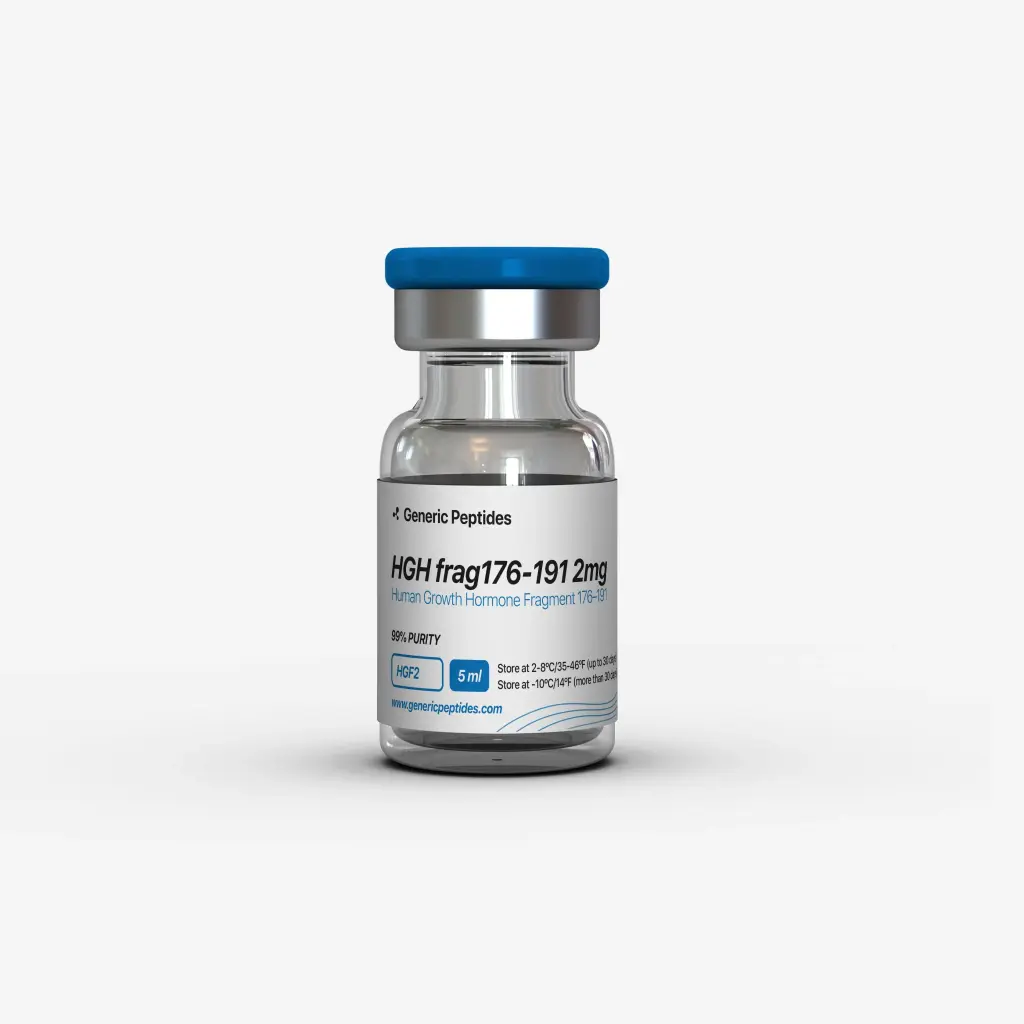
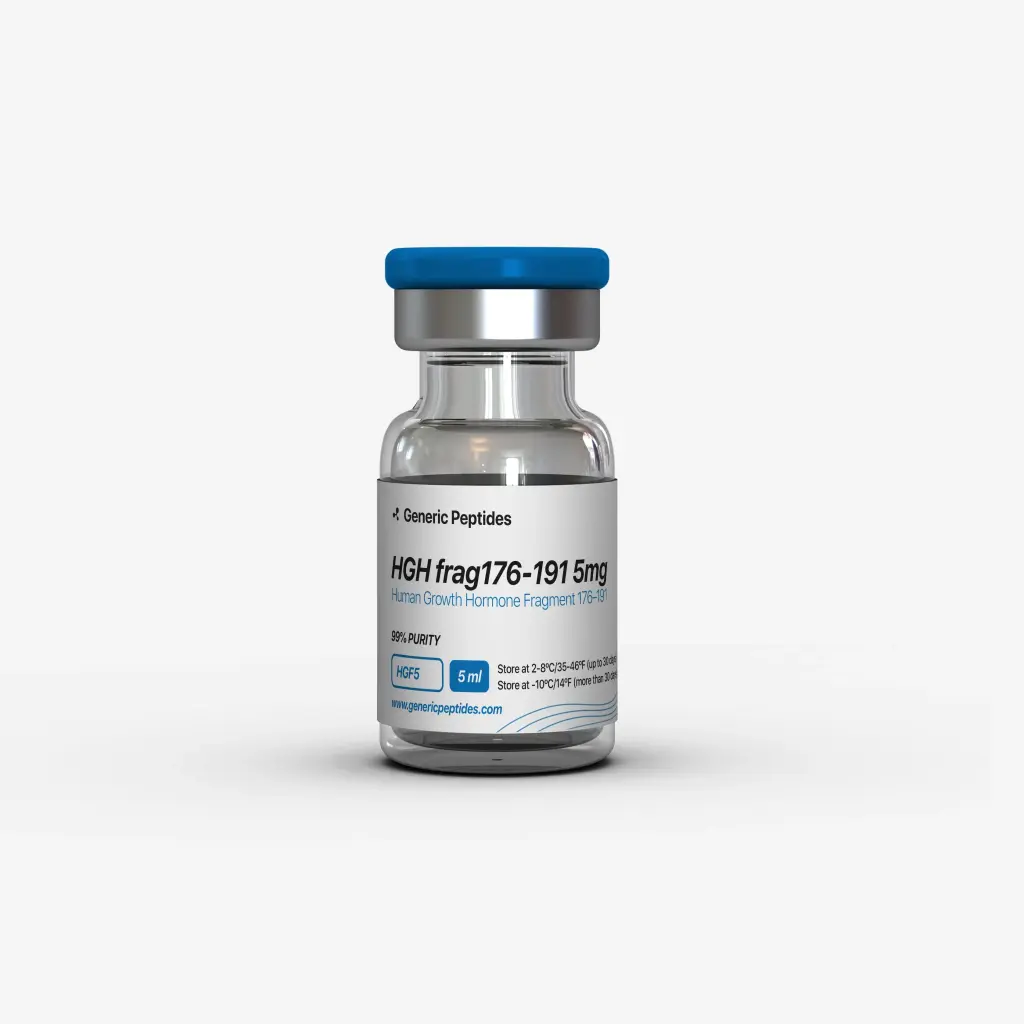
Buy HGH Frag 176-191 by Generic Peptides at XSteroids. HGH Frag 176-191 is the 16-amino-acid tail of human growth hormone, the region that laboratory work links to fat mobilisation, and Generic Peptides lists the fragment as lyophilized powder with a 2 mg or a 5 mg vial option. It is the native piece of the hormone, not the substituted analogue, and that difference matters. This page covers what is in the vial, how the fragment is thought to act and what has been observed.
The central limit: the native fragment has never been through clinical trials of its own, and no human half-life or human dose has been established. Human fat-cell work in the literature belongs to closely related substituted peptides, not to this exact sequence.
What ships is a single glass vial holding white lyophilized powder, made up in 2 mg or 5 mg, capped with a stopper under a crimp. Bacteriostatic water, sterile water, syringes and swabs do not come with it and must be ordered alongside. The listing covers both fills, so the milligram figure belongs to the pack option and not to the product name.
The peptide reproduces residues 176 to 191 of the human growth hormone tail, a sixteen-residue stretch whose single-letter code reads FLRIVQCRSVEGSCGF; the two cysteines are joined by a disulfide bridge and the mass is near 1817 g/mol. It is not the same molecule as AOD 9604, which occupies the same region of the hormone but carries a tyrosine in place of the natural phenylalanine at the front end. Two similar-looking sequences, two different peptides, and the substitution changes stability and handling.
Growth hormone acts through its own receptor and triggers a broad response, including liver production of IGF-1 and effects on growth, connective tissue and glucose handling. The 176-191 region is the part of the molecule that animal work associates with fat mobilisation, and the research idea behind the fragment is to isolate that activity and leave the rest of the hormone behind. The theory is simple. The supporting human data are not.
In several animal models the fragment reduced fat percentage while producing little of the growth effect seen with the whole hormone, and that separation is the reason the fragment is marketed at all. It is important to be precise here: the lack of an IGF-1 rise has been reported in animals, and it has not been confirmed in humans, because the native fragment has not been tested in humans. Claims that it raises or does not raise IGF-1 in people are extrapolation.
No human pharmacokinetic profile exists for the native sequence. Nothing reliable is published on how quickly it appears in plasma after a subcutaneous injection, how long it persists or how it is cleared, and the supply side does not publish those figures either. The practical consequence is short: dosing intervals used in the field are conventions copied between vendors rather than the output of a dosing study.
What exists is animal work on body composition. Rodent studies show lower fat percentage after treatment with the fragment, usually with no obvious growth signal. What does not exist is a human trial of this sequence: no phase 1, no phase 2, no body-composition endpoint in people, and no measured marker after dosing that a buyer could compare against.
The human fat-cell literature that is often quoted in this context studied closely related substituted peptides rather than the native tail. Published work on lipolysis in human adipose tissue used the AOD variants, which is a different molecule with a different stability profile. Treating those results as if they described the vial in this listing is the most common error in fragments marketing.
Supplier material describes a typical research course of 4 to 12 weeks with fat loss appearing gradually. That is a vendor timeline with no published study behind it. If you are running a personal experiment, a scale, a waist measurement and a fixed food log will produce more usable information than any expectation written on a product page.
Measure the water first and the rest follows. One millilitre added to the 2 mg vial yields 2 mg/ml, so the 10-unit mark on a U-100 syringe carries 200 mcg; two millilitres halve that to 1 mg/ml and 100 mcg at the same mark. For the 5 mg vial the pair runs 2 ml to 2.5 mg/ml, which is 250 mcg per 10 units, or 1 ml to 5 mg/ml and 500 mcg per 10 units. Gently swirl the vial; shaking is not used.
Vendor notes describe 200 to 500 mcg per day, often split into two injections, over cycles of 4 to 12 weeks. At 250 mcg daily a 2 mg vial lasts about 8 days and a 5 mg vial about 20 days. Those are conventions borrowed between vendors, not the output of a human dosing study.
The natural comparison is AOD 9604, the substituted relative of the same tail, while Adipotide takes the vascular route to the same goal. Somatropin is the full hormone and therefore the reference for anything attributed to growth hormone, and Tesamorelin is the GH-releasing peptide with visceral fat data. For appetite-driven plans the comparators are Semaglutide and Tirzepatide. Repair-focused stackers often add TB 500. None of those pairings has been run as a combination.
The fragment is not a hormone, so nothing in it suppresses natural testosterone and post-cycle therapy has no target. What does apply is cycle structure. Supplier notes suggest 4 to 12 weeks of use followed by a break, and a break also restores an unmanipulated baseline for measurement.
Because the native sequence has never been given to people, no human safety dataset exists for it. Statements about growth hormone fragments in general trace back to the substituted analogue, and they cannot be carried over. Any subcutaneous peptide can leave redness or swelling at the injection site.
The WADA Prohibited List places growth hormone fragments in class S2.2.3, and hGH 176-191 appears there by name; the class is banned continuously, in and out of competition. No regulator has approved the peptide as a medicine.
Do not treat the fragment as a substitute for full growth hormone or for medical care. Keep it away from anyone under 18, anyone pregnant or breastfeeding, and anyone using prescription medication without medical advice, and do not use a vial with a damaged crimp or a discoloured powder.
The powder keeps between 2 and 8 C, shielded from light, and a freezer is the right place for storage measured in months. Once reconstituted, hold it at 2 to 8 C and use it up inside 28 to 30 days; freezing the solution is not done. Warm the vial to room temperature before drawing, disinfect the stopper with an alcohol swab, and keep the water lot and the vial lot documented so each syringe reading can be checked.
Both fills of Generic Peptides HGH Frag 176-191 are stocked at XSteroids inside the Generic Peptides category. Compare the sequence with the AOD 9604 card, and read Adipotide if the vascular mechanism matters more. Use the arithmetic above to pick the fill, then hold the made-up solution no longer than 30 days.
They are close relatives, not identical. Both copy residues 176 to 191 of human growth hormone, but AOD 9604 replaces the natural phenylalanine at the front of the chain with a tyrosine, a change made to improve stability and oral uptake. Unmodified HGH Frag 176-191 is the plain sequence.
Animal studies suggest the fragment mobilises fat without the growth-promoting and IGF-1 effect of the intact hormone, which is the whole reason it is studied separately. That separation has not been confirmed in controlled human trials, so it remains a working hypothesis rather than an established fact.
Not as the fragment. The human trial record belongs to full growth hormone and to AOD 9604, its modified cousin, not to unmodified 176-191. Anyone presenting human results for this exact sequence is most likely describing one of those relatives or an animal study.
Base the calculation on vial volume. A 5 mg vial with 2 ml of bacteriostatic water gives 2.5 mg/ml, so 0.1 ml contains 250 mcg and reads as 10 units on a U-100 syringe. A 2 mg vial with 1 ml gives 2 mg/ml, where 10 units hold 200 mcg. Swirl gently, never shake.
Supplier write-ups usually quote 200 to 500 mcg per day, frequently split into two injections, over cycles of four to twelve weeks. At 250 mcg daily a 2 mg vial lasts about eight days and a 5 mg vial about twenty. No approved human dose exists for this peptide.
Yes. The Prohibited List names growth hormone fragments as a class and cites hGH 176-191 as an example, under class S2. The ban applies at all times with no in-competition window, and because the fragment is not an approved medicine there is no realistic route to a therapeutic use exemption.
You can buy HGH Frag 176-191 by Generic Peptides online at XSteroids, straight from the brand catalog. Select the 2 mg or 5 mg vial on this page, add it to the cart and finish the order with secure checkout, US domestic shipping in 3 to 6 days and international delivery in 12 to 26 days.
Loading...
Your cart is currently empty. Let us assist you in finding the right product