Quick View
Loading...

Generic Peptides
Estimated Delivery: 12-26 Days (International), 3-6 Days (United States)
Return within 45 Days of purchase. Duties & taxes are non-refundable.
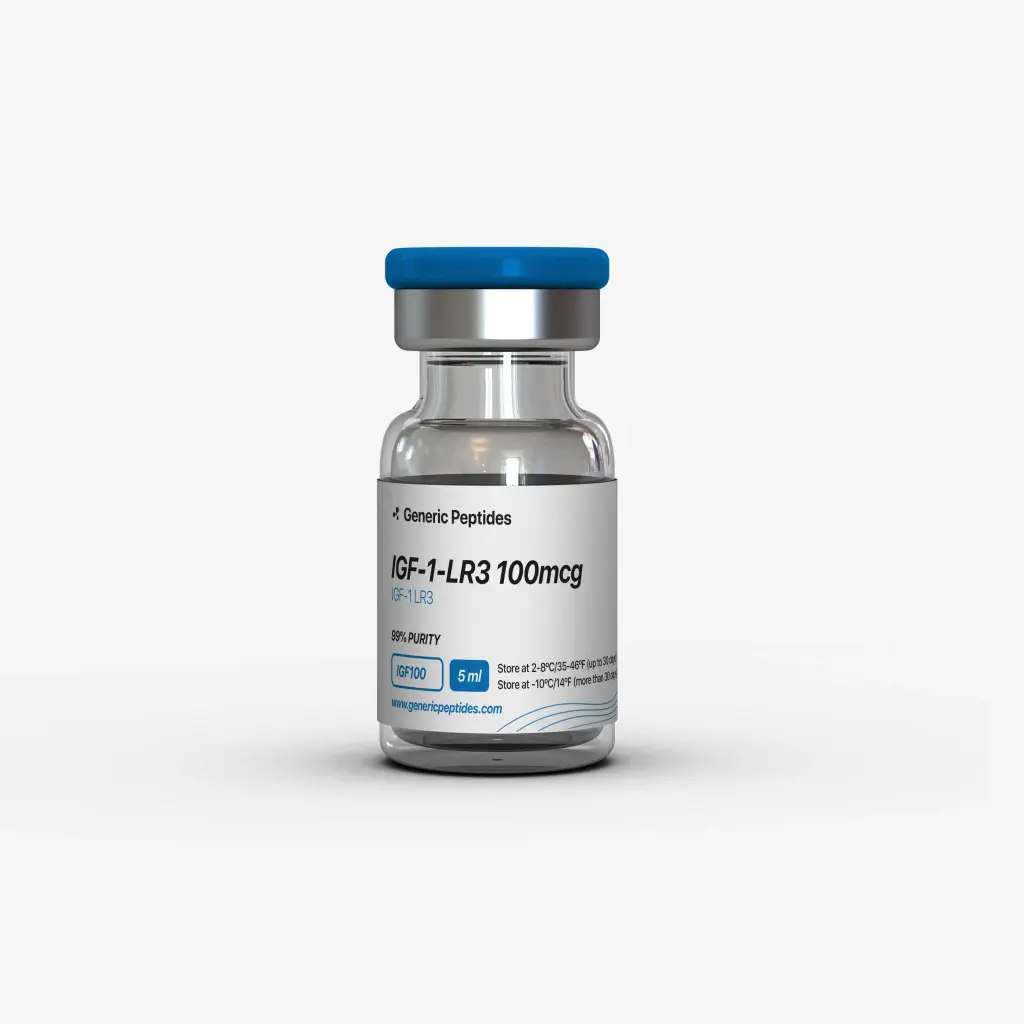
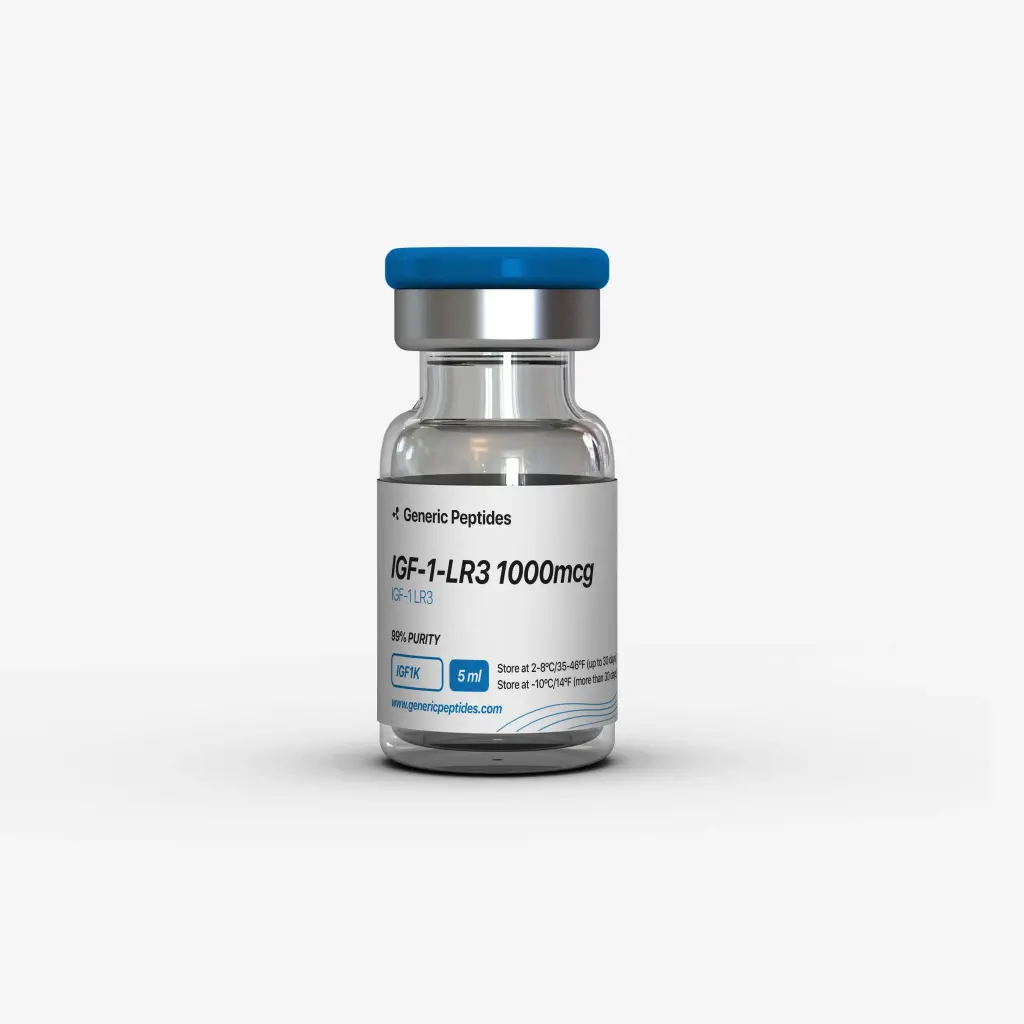
Buy IGF-1 LR3 100 mcg and 1 mg by Generic Peptides at XSteroids. This molecule is neither a growth hormone secretagogue nor a fragment peptide: it is an extended analogue of insulin-like growth factor 1, built to last longer and to slip past the binding proteins that would otherwise tie IGF-1 up in circulation. The brand ships it as a lyophilized vial, and the sections that follow take in the chemistry, the pharmacokinetic figures, the mixing sums, the blood sugar question and the sporting ban.
The vial is laboratory material. No country has ever licensed IGF-1 LR3 as a medicine, and this page is information rather than medical advice.
Long arginine 3-IGF-1, also written LR3-IGF-1, is a synthetic protein built from human IGF-1. Its identity rests on two structural edits: glutamate in position three is swapped for arginine, the change that gave the molecule its name, and thirteen further amino acids hang off the N-terminus, which takes the chain from the 70 residues of native IGF-1 to 83.
The consequences are practical rather than cosmetic: the molecule keeps its activity at the IGF-1 receptor, gains a very low affinity for the IGF binding proteins and becomes far more stable in circulation. Generic Peptides lists a 100 mcg vial and a 1 mg vial of lyophilized powder, and the difference between those two sizes matters when a protocol is measured in micrograms.
One glass vial of sterile lyophilized IGF-1 LR3 makes up the pack, in the 100 mcg or the 1 mg size, and nothing else is inside. Because the molecule is a protein rather than a short peptide, the microgram vial runs out quickly and the arithmetic deserves attention. Diluent, syringes and swabs are sourced separately; kept dry, the product is much more stable than any solution, and it dissolves to a clear liquid.
IGF-1 LR3 is an agonist at the IGF-1 receptor, the same receptor that mediates most of the growth and repair signal attributed to growth hormone. Because it largely escapes the binding proteins, more of the dose is available to the receptor, and the literature describes it as roughly three times more potent than IGF-1 with a much longer circulating life.
The main text on the compound puts the half-life at about 20 to 30 hours, against 12 to 15 hours for native IGF-1. The infobox on the same source lists an elimination half-life of 56 to 72 hours, so the honest position is that published figures disagree and that no human pharmacokinetic study of the LR3 analogue exists. What is clear is that this is a long acting molecule: an injection does not behave like a peptide that clears in minutes.
IGF-1 LR3 does not touch the pituitary. Where sermorelin, ipamorelin and hexarelin make the body release its own growth hormone, LR3 supplies the downstream factor directly and acts on the IGF-1 receptor in muscle and other tissue. That puts it on the same pathway as PEG MGF, the local muscle splice variant of IGF-1, but LR3 is systemic and long acting while MGF is meant to stay local. It is also the only compound in this group that carries a blood sugar warning inherited from the IGF-1 class.
Almost none of the human data were collected on LR3 itself. The approved IGF-1 product is mecasermin, a recombinant IGF-1 used in severe primary IGF-1 deficiency, and its label carries a hypoglycaemia warning because IGF-1 signalling lowers blood glucose. LR3 shares the receptor and the glucose effect but has never been through clinical trials, so everything said about its behaviour in people is extrapolation from the class.
Published figures for the half-life disagree openly. The main text on the compound puts it at about 20 to 30 hours against 12 to 15 hours for native IGF-1, while the infobox on the same source lists an elimination half-life of 56 to 72 hours. No human pharmacokinetic study of the LR3 analogue exists. What both sets of numbers agree on is the practical point: this is a long acting molecule, and an injection does not behave like a peptide that clears in minutes.
Because the compound is long acting and lowers blood glucose through the class mechanism, the marker that matters most is glucose rather than growth hormone. Research write-ups keep amounts small, 20 to 50 mcg a day in most vendor texts, and cycles short, around three to four weeks, which reflects the limited human data rather than a validated schedule. There is no approved dose, no approved indication and no evidence that LR3 produces the muscle growth claimed for it.
Start with the 1 mg vial: 1 ml of bacteriostatic water gives 1 mg per ml, so a 0.1 ml volume carries 100 mcg, while 2 ml of water halves the strength to 0.5 mg per ml and 50 mcg per 0.1 ml. The 100 mcg vial is different arithmetic, because 1 ml of water leaves 100 mcg per ml and only 10 mcg in each 0.1 ml. Whichever vial is used, the syringe reads that 0.1 ml volume as 10 units on the U-100 scale.
Vendor write-ups cluster around 20 to 50 mcg a day by subcutaneous or intramuscular injection, with some sources stretching the top of the range to 100 mcg, and cycles of about three to four weeks. At 50 mcg a day the 1 mg vial lasts about 20 days; at 20 mcg a day it lasts about 50 days. These are supplier conventions for research material, not approved doses, and the compound has no approved indication anywhere.
IGF-1 LR3 sits downstream of growth hormone, so the compounds around it are the ones that act upstream. PEG MGF is the other muscle repair peptide in this catalog and is the closest neighbour in research write-ups, while Sermorelin and Ipamorelin drive the body's own growth hormone release. Somatropin raises IGF-1 through the liver rather than supplying an analogue, and TB 500 works on tissue repair through a completely different pathway.
IGF-1 LR3 does not suppress the androgen axis, so a peptide block does not require post-cycle therapy. The recovery question here is different: because the analogue is long acting and raises IGF-1 signalling directly, blocks are kept short, typically three to four weeks, with a break in between. Anyone stacking an androgen cycle alongside handles recovery on the anabolic side, and this brand carries no such products. Blood glucose deserves attention regardless of what else is running.
IGF-1 signalling lowers blood glucose, and hypoglycaemia is a class level risk rather than a rumour: the approved recombinant IGF-1 product mecasermin carries that warning, while the LR3 analogue has no human clinical trials at all. Symptoms worth knowing are shakiness, sweating, hunger and confusion. Other reported issues in this family include injection site reactions, joint and muscle discomfort and fluid retention.
Treat the vial as laboratory material and the page as information only. Diabetes, a history of hypoglycaemia, active cancer or a pituitary disorder are all reasons to keep hands off it unless a clinician is supervising, and it has to be stored beyond the reach of children.
Powder stays between 2 and 8 C in the dark, and only untouched vials destined for long storage go into a freezer. A mixed solution keeps at 2 to 8 C for 28 to 30 days at most. Never freeze or shake a reconstituted vial, and discard it the moment it looks cloudy.
XSteroids fulfils IGF-1 LR3 orders from the Generic Peptides brand catalog itself, with an encrypted checkout and tracking on every parcel. Delivery takes 3 to 6 days within the United States and 12 to 26 days for the rest of the world. Both vials, the 100 mcg and the 1 mg, are shown above, and the products below gather the growth hormone peptides and the repair compounds that sit beside an IGF-1 research plan.
Two structural changes. An arginine replaces glutamic acid at position three, which is the arginine 3 part of the name, and thirteen extra amino acids sit on the N-terminus, giving 83 amino acids instead of 70. The result keeps IGF-1 receptor activity, has very low affinity for the IGF binding proteins and is roughly three times more potent.
It depends on the amounts involved. A 1 mg vial mixed with 2 ml gives 0.5 mg per ml, so a 50 mcg amount is 10 units on a U-100 syringe and the vial lasts about 20 days at that amount. The 100 mcg vial is better for very small quantities, where each 10 units equals 10 mcg.
Add bacteriostatic water slowly down the vial wall, 1 ml for 1 mg per ml or 2 ml for 0.5 mg per ml, then swirl rather than shake. Keep the lyophilized vial at 2 to 8 C away from light, and the mixed solution at 2 to 8 C for no more than 28 to 30 days. Never freeze a reconstituted vial.
The main reference text puts it at about 20 to 30 hours against 12 to 15 hours for ordinary IGF-1, while the infobox on the same page lists 56 to 72 hours. Published figures disagree and no human pharmacokinetic study of this analogue has been done, but all sources agree it is far longer acting than native IGF-1.
IGF-1 signalling reduces blood glucose, so hypoglycaemia is a recognised class risk. The approved recombinant IGF-1 product mecasermin carries that warning, and shakiness, sweating, hunger or confusion are the usual signs. The LR3 analogue itself has never been tested in human clinical trials, so the size of the risk is unknown.
It is not approved anywhere. An approved recombinant IGF-1 exists for severe primary IGF-1 deficiency, but that is a different molecule. For athletes, IGF-1 and its analogues are named in class S2 of the WADA prohibited list and banned at all times, so the LR3 analogue is prohibited material.
IGF-1 LR3 by Generic Peptides is available online at XSteroids, ordered from the brand catalog itself. Checkout is encrypted, US parcels take 3 to 6 days to arrive and international parcels 12 to 26 days. Add the 100 mcg or the 1 mg vial to your cart on this page to place the order.
Loading...
Your cart is currently empty. Let us assist you in finding the right product