Quick View
Loading...

Generic Peptides
Estimated Delivery: 12-26 Days (International), 3-6 Days (United States)
Return within 45 Days of purchase. Duties & taxes are non-refundable.
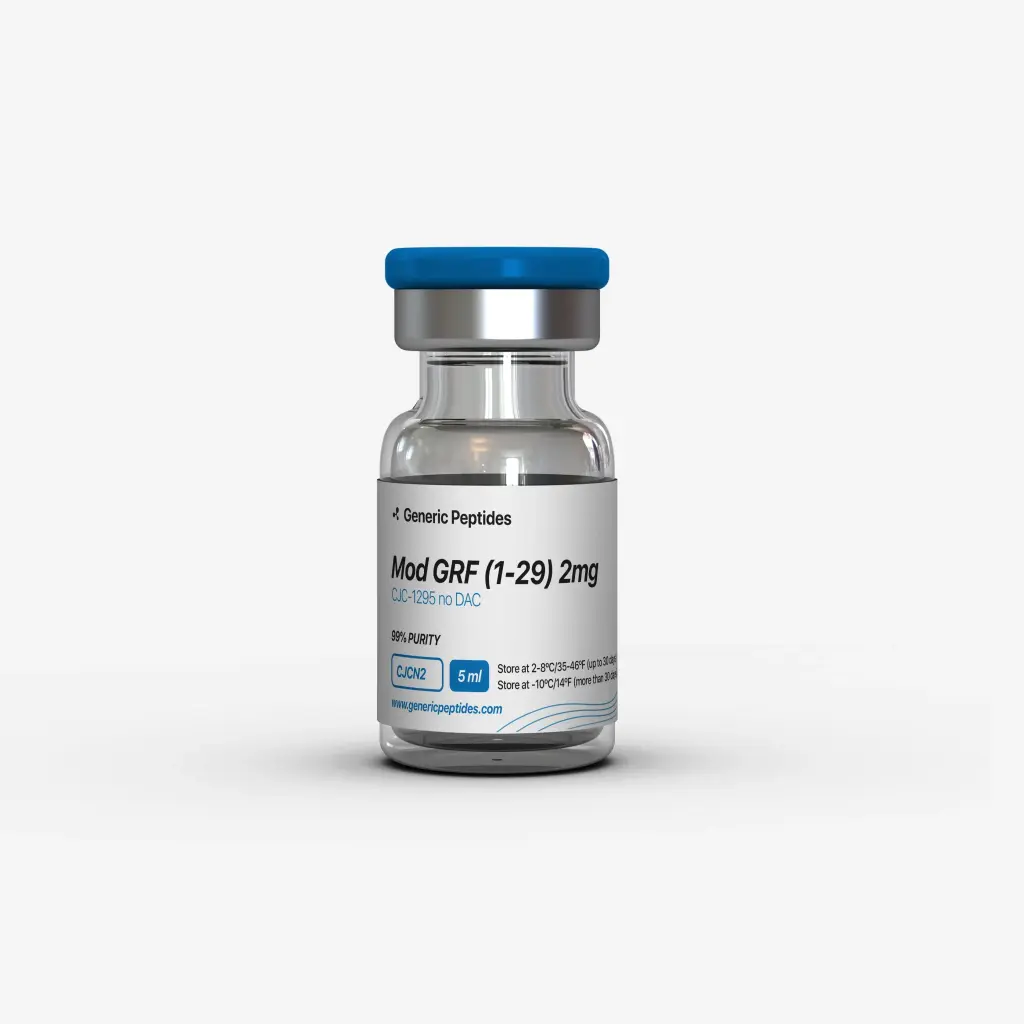
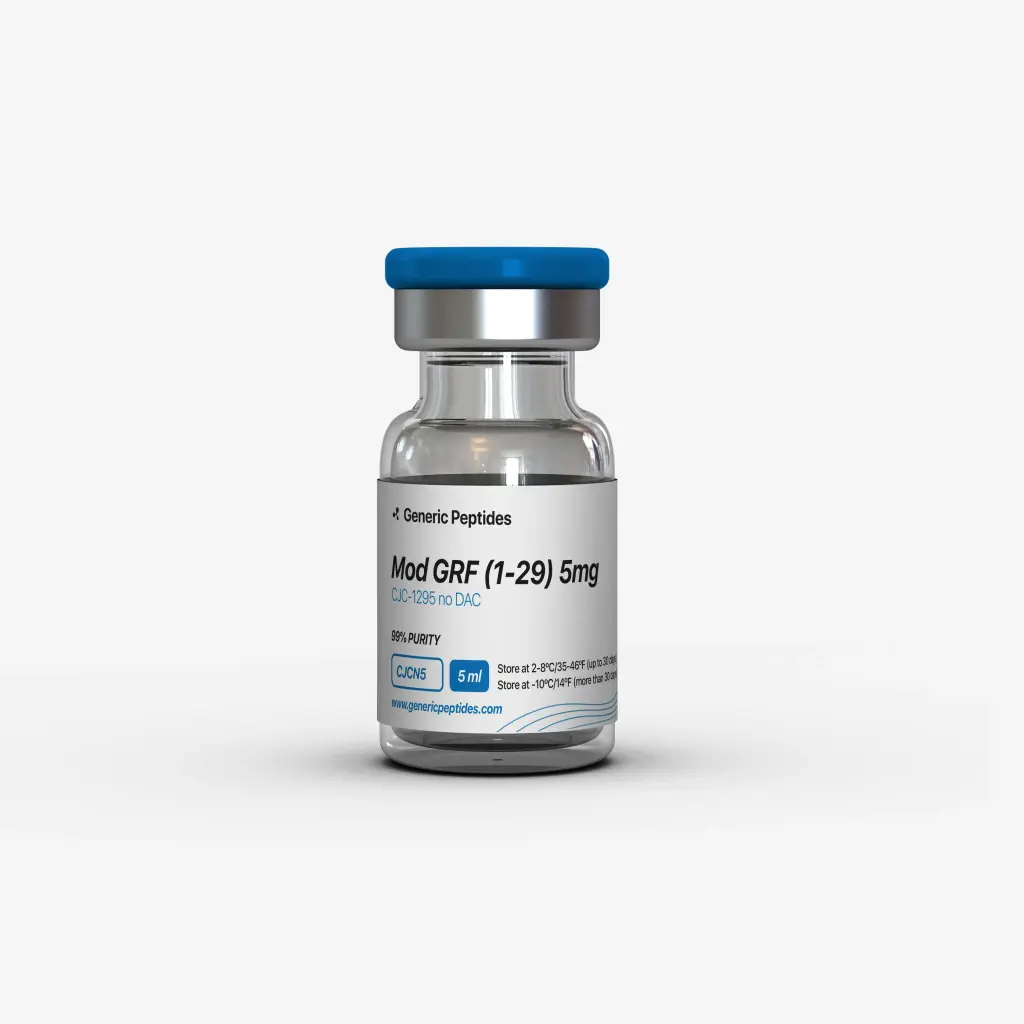
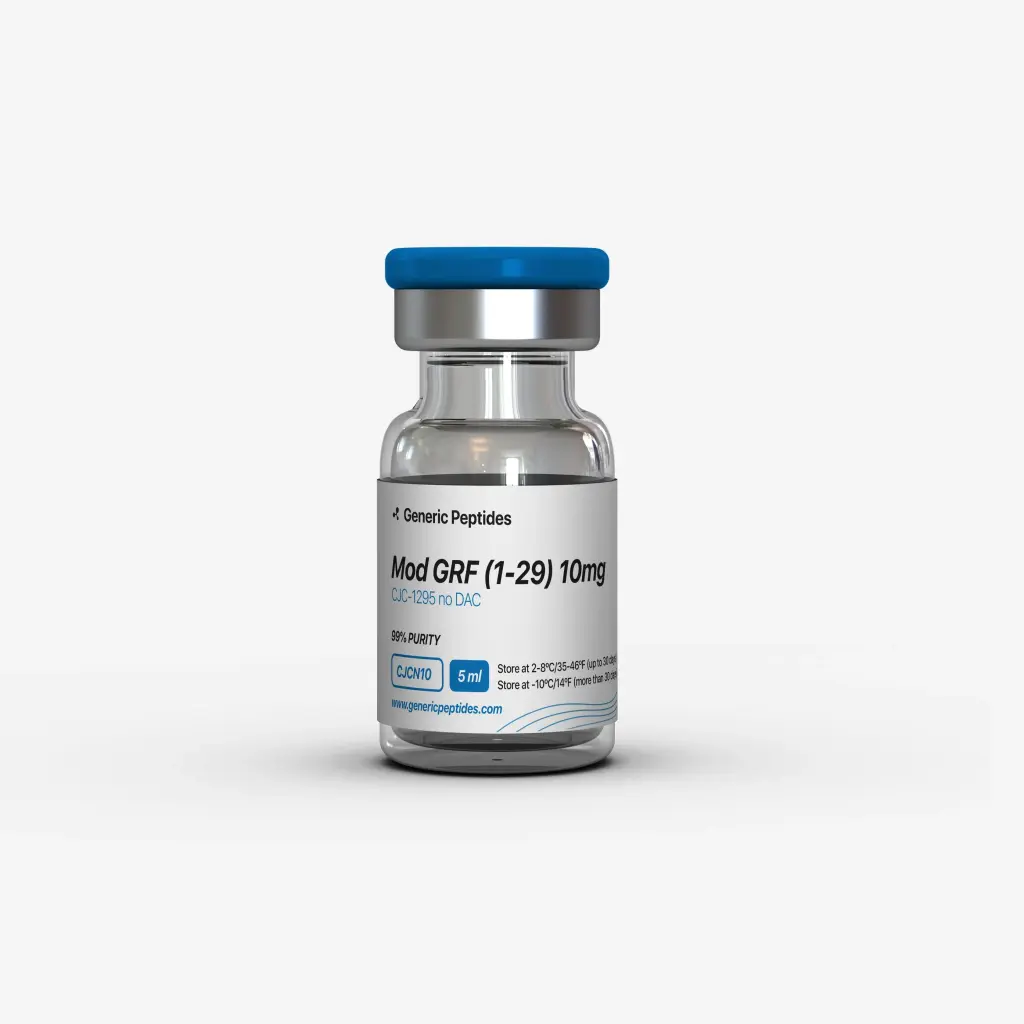
Buy CJC-1295 (no DAC) vials, 2 mg, 5 mg and 10 mg, by Generic Peptides at XSteroids. This is the short-acting GHRH analogue, usually written as mod GRF 1-29, supplied as lyophilized powder for laboratory work. The page explains the peptide, why dropping the DAC transforms how it behaves, what studies reported, how to mix each vial and how a dose reads on a U-100 syringe, then stacking, storage and legal questions.
Neither form of CJC-1295 is licensed and there is no ATC code for it. What follows describes bench material only, and none of the figures is an approved dose for people.
This peptide keeps the 29 amino acid backbone of GHRH, the growth hormone releasing hormone, with four substitutions that protect it from being chopped up by the DPP-4 enzyme. What it does not carry is the drug affinity complex, the albumin-binding tag that the DAC version uses to survive for days. Without that anchor the peptide behaves like a short pulse, and the sequence is usually labeled mod GRF 1-29 or modified GRF 1-29.
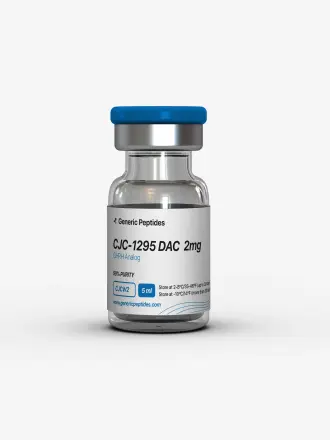
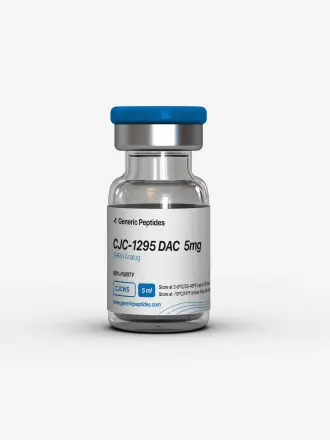
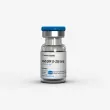
A pack of this product is a single glass vial holding white lyophilized powder in one of three strengths: 2 mg, 5 mg or 10 mg. Water for mixing is not included and must be bought on its own. No filler list is published, and no independent potency test is on record, so only the supplier's own documentation is repeated on this page.
Like every GHRH analogue, this peptide docks on the GHRH receptor of pituitary somatotroph cells and asks them to release stored growth hormone. The DPP-4-resistant substitutions are what make it usable at all, because the native hormone is degraded within minutes. Even with that protection, the reported half-life of the no DAC version is only about 30 minutes, which is short enough that the pituitary output resembles a single pulse instead of a plateau.
That is the defining difference from the DAC product. The DAC version binds albumin and keeps the receptor stimulated for days, flattening the pulse. The no DAC version gives one sharp signal and then disappears. The natural pattern of growth hormone release is pulsatile, so researchers who want to mimic physiology rather than sustain a level choose the short peptide and pair it with a ghrelin secretagogue that fires the same pulse from a different receptor.
Because the peptide clears in about half an hour, laboratory schedules using it are frequent, typically timed around sleep or split across the day. The no DAC version is normally combined with a secretagogue such as a GHRP so that the two receptors are triggered together. The markers are the usual growth hormone axis readouts: growth hormone itself and IGF-1.
Human safety data for long-term use of this short peptide are limited, and this page will not dress that up. What the class literature establishes is the mechanism and the pharmacokinetics, not a clinical outcome. Any promise of fat loss, recovery or sleep quality attached to mod GRF is marketing text, and the sources behind this page do not support it. Where the data stop, this page stops.
The distinction that matters most in a lab notebook is time. With the DAC sibling, one injection keeps IGF-1 elevated for weeks, so the washout between two comparison arms is long. With mod GRF the signal is gone within hours, which makes before-and-after sampling easier but demands many more injections to hold a schedule. Neither pattern is physiological in a strict sense; the sources describe both as research tools rather than treatments.
Draw up the numbers this way. Divide the milligrams in the vial by the millilitres of water added to get mg per ml. A U-100 barrel counts 10 units for each 0.1 ml. A 2 mg vial plus 1 ml lands at 2 mg per ml, so 0.1 ml holds 200 mcg. A 5 mg vial plus 2 ml lands at 2.5 mg per ml, so 250 mcg sits in each 0.1 ml. The 10 mg vial with the same 2 ml reaches 5 mg per ml, and 0.1 ml of it holds 500 mcg.
Because the peptide is short-lived, one mixed vial covers several sessions, so write the strength on the label and store the vial cold between draws. Swirl instead of shaking, and never refreeze a thawed solution.
The classic research pairing is a GHRH analogue plus a ghrelin receptor agonist. The two short secretagogues are GHRP-2 5 mg and 10 mg alongside GHRP-6 5 mg and 10 mg, whereas Ipamorelin 2, 5 and 10 mg is the pick when selectivity matters and Hexarelin 2 and 5 mg is the strongest of the family.
The long-acting route is its sibling, CJC-1295 DAC 2, 5 and 10 mg, and Somatropin 100 to 200 IU is the direct hormone rather than a releasing signal. No combination listed here is approved for human use.
Nothing on this page suppresses the androgen axis, so post-cycle therapy is not part of the picture: the peptide sits above the testosterone system and does not shut down natural production. If it is used alongside an anabolic plan, recovery still belongs to the anabolic side. For laboratory work, IGF-1 is the more stable marker because it moves slowly, while growth hormone itself rises and falls within the dosing window and is harder to capture. Laboratory notes should record the injection time, since the peptide is gone within the hour and a late sample will miss the peak entirely.
Reported reactions follow the growth hormone class: injection site irritation, fluid retention, joint or muscle aches and shifts in glucose handling. Because the half-life is short, the exposure per dose is smaller than with the DAC version, but this does not make the compound approved or benign. Releasing factors and secretagogues belong to WADA class S2 and are banned at all times, and there is no approved medical product of this kind.
Powder in the dry state is kept between 2 and 8 C, out of the light, and must never be frozen. After water is added, keep the vial cold in the refrigerator and use the mixed solution up within 28 to 30 days. Throw away any solution that looks cloudy or holds particles.
CJC-1295 (no DAC) can be ordered at XSteroids straight from the Generic Peptides brand catalog. Every strength sits together on one page, checkout runs over a secure connection, US customers see delivery in 3 to 6 days and international customers in 12 to 26 days. Cards further down cover the long-acting sibling and the secretagogues it is normally researched with.
DAC stands for drug affinity complex, a side chain that binds the peptide to albumin and stretches its activity to days. The no DAC version keeps the four substitutions that resist enzyme breakdown but leaves the side chain out, so the peptide is cleared in about 30 minutes and produces a short hormone pulse instead of a plateau.
Only the pharmacokinetics differ: same 29 amino acid GHRH backbone, same four stabilising substitutions, no albumin anchor. The DAC version lasts about 6 to 8 days and is discussed weekly, while this one lasts around 30 minutes and is timed around sleep or training. Neither is approved for human use.
Without the albumin-binding side chain, the peptide is exposed to normal clearance. The four substitutions in Mod GRF 1-29 protect it from DPP-4 cleavage, which is what keeps the window at minutes rather than seconds, but there is nothing in the molecule to hold it in circulation once it enters the blood.
A ghrelin receptor agonist is the usual partner, since the two act on different receptors. Ipamorelin is chosen for the cleanest hormone profile, GHRP-2 and GHRP-6 when appetite matters, and hexarelin when the strongest release signal is wanted. No regulator has approved any of those combinations for human use.
Divide the milligrams by the millilitres added. With 2 ml a 5 mg vial gives 2.5 mg per ml, so 0.1 ml holds 250 mcg and reads as 10 units on a U-100 syringe. With 1 ml the concentration doubles and 0.1 ml holds 500 mcg. Swirl the vial, never shake it.
No. There is no approved form, no approved dose and no marketing authorisation for this peptide anywhere. The vial sold here is a research product for laboratory work. In sport the class is covered by WADA class S2, which bans growth hormone releasing factors at all times.
You can buy CJC-1295 (no DAC) by Generic Peptides online at XSteroids, direct from the brand catalog. Choose the 2, 5 or 10 mg vial on this page and check out securely. US domestic shipping takes 3 to 6 days, and international delivery takes 12 to 26 days.
Loading...
Your cart is currently empty. Let us assist you in finding the right product